Pages

Saturday, August 31, 2013

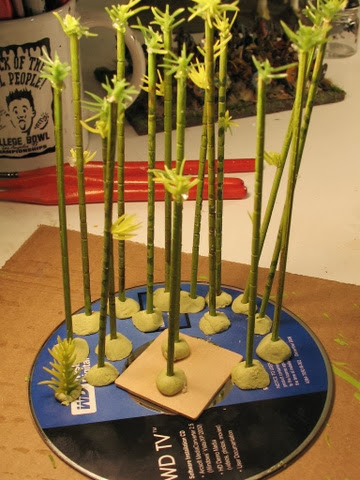
Terrain Project: Bamboo Thicket

Skirmish games such as SAGA and Ronin are a compromise between wargaming and miniature roleplaying.  Models become characters whose individual actions or successes can affect the course of the game.  With that sense of individuality, interaction with terrain is even more exact.  For Ronin, a bamboo forest is necessary to instantly evocative of East Asian landscapes.

I started with a number of round wooden craft sticks, about 1/8" in diameter.  They seemed to actually be real bamboo, not that it makes a difference on a scale miniature.


At first, I placed the stick in the chuck for a hand drill and then held a small file against the "bamboo" while turning it. This created the segmented nodes on the stem. Having three hands would have helped in this process.  If one has a drill press (second photo below), there is less chance of breakage and the notches are better defined, but it is a slower process to change out.  


The notched bamboo was painted light green with craft paint.  Next, foliage from an aquarium plant was glued to the top and sides.  I detailed the cane with a black wash to highlight the segments, then some drybrush highlighting. 


The bamboo was attached to a CD base with Miliput putty, and then covered with a glue/paint/ballast mixture.


With a couple of these on the table,  the terrain is evocative of so many settings in samurai and wuxia films.  Maybe on my next piece, I'll figure out a way to let my models do this: 


Monday, August 26, 2013

Sohei Monks for Ronin


The origins of Japan's warrior monks start with the relocation of the imperial capital from Nara to Heian in the late eighth century.  Disputes broke out between monks from the two cities over issues of imperial favoritism and patronage.  In 949, violent conflict, on the level of street brawls and skirmishing erupted between rival orders.  As central authority declined in the eleventh and twelfth century, battles between the rival temples became larger in scale, and the Nara monastary fielded an army of over 3,000 Sohei. In the Gempei Wars of the 1180s, the Nara monks sided with the Minamoto clan. Their rivals, the Taira, so decisively destroyed the monks and their temple, that most Sohei stayed out of the remainder of the wars.

My Sohei buntai is mostly from The Assault Group, one of the few companies making models for the early Samurai period.  As always, their figures are truly a joy to paint.  Details are vivid, but not exaggerated.  The fabric on the robes is natural and shows off shading and highlighting.  I wish my painting did it better justice.


Not a lot of posing variance on the archers, but for a small warband, a shooting stance is what I want. 


The unarmed monk is center is something I have had since the early 90s, and recently repainted.  He can fit in as a Shugyosha.  Can anybody ID its manufacturer? 


Reading Background:

Japanese Warrior Monks AD 949-1603, by Stephen Turnbull and illustrated by Wayne Reynold. Stephen Turnbull is Osprey's go-to-guy for ancient and medieval Asian history and this is essential if one wants to learn the history, motivation and equipment of the Sohei.  Reynold's illustrations are very good with bold line work and nice color contrasts.

Japanese Fortified Temples and Monastaries AD 720-1062. Fortress Monasteries. by Stephen Turnbull and illustrated by Peter Dennis.  Across his numerous Osprey titles, Turnbull can be a bit redundant.  If one has the previous volume, Fortified Temples is probably non-essential.  Its focus on fortress monasteries has some potential for those wanting to build their own terrain. Most of the illustrations are architectural in nature, but a couple of Dennis' plates are battle scenes.  They lack the scope and impact of Wayne Reynolds, but are still useful for the painter needing reference. I also wonder if the title is in error, because the bulk of the material and illustrations deal with fighting monks and their castles well into the fifteenth and sixteenth centuries.

The Dragon Scroll, I.J. Parker.  In this Heian-era mystery, a young Japanese bureaucrat's investigation of tax irregularities in a province lead him to a nearby temple whose members have been instigating violence in the nearby village.  The lead character in the series, Akitada, is continually skeptic of Buddhism - or more likely distrustful of the degree to which the monasteries insinuated themselves into the corridors of power.

Monday, August 12, 2013

Andalusian Cavalry


My El Cid/Spanish project continues to expand with this unit of recently completed Andalusian Cavalry from Gripping Beast.  The set of ten contained a mix of Christian/Muslim knights, befitting the mercenary nature of some of the Taifa kingdoms' armies.


The only issue I have ever had with any Gripping Beast figures is the choppy or rudimentary look of the horses.  On these, I have no complaints.  The details are sharp, especially on the heads and harnesses.


Also completed this week, after about 6 weeks in the making, is this Norman watchtower.  I originally intended for it to be the keep for a castle complex, but that proved to be too ambitious.  Castles are nice to have, but there has yet to be a rules system that wants to fully tackle the intricacies of ancient and medieval siege warfare. The sides are built from Hirst Arts blocks and the floors from molded plastic sheets found in the railroad modeling section of a hobby store.


With that in mind, I changed it to a stone coastal watchtower with a hay signal beacon on top.  The floors and door are removable and can hold about a dozen models inside. 


The hay stack is made of Milliput and the groove on the side will be used to attach a steel wool "fire." Below, some Norman archers take aim.


I have some WIP photos that I might attach with a write up soon. 

Wednesday, August 7, 2013

New App Recommendation & Other Updates

While there has not been a great deal of posting lately here at Sea Kings and Horse Warriors, I promise I have been busy.  In late July, my armies of El Cid era Spain added 10 Andalusian cavalry, 25 Sudanese spearmen, a dozen slingers and some various Christian knights.

On the terrain front, I have built a stone Norman tower and most of a large Spanish church, both from Hirst Art blocks.  A lot of plaster has been poured in my garage recently.  Other terrain projects that have been completed are two farm houses, 4 lengths of wattle fencing and a small vegetable field. I will post some photos, but the Dullcote is drying slow in the rainy and humid South.

I have never reviewed or recommended a phone/tablet app, but this particular app seemed interesting.  I have never been a user of digital dice apps, preferring the primitive satisfaction of tossing the magical plastic onto a wood table, but at 50% off, Prime Dice D & D pro was in the impulse buy price range.  Of course, it has all of the D & D multisided dice, which can be rolled in various quantities and combinations.  Tapping on a single die rerolls that dice only.  It also supports multiple tables, so two players can roll their dice quickly by swiping horizontally from one background to the other.  There are some good stock backgrounds (pictured) but custom or personal backgrounds can also be loaded.  Even better, the dice themselves can be customized.  I immediately thought of the possibilities of story dice for my kids - loading images of dragons, castles, spaceships or dinosaurs. My first experiment was to create some virtual SAGA dice:


While not very practical (how can I put them on a battleboard?), I can see using the custom dice features in SAGA and other mini games for things such as random weather effects, civilian or livestock actions and other scenario specific situations.  

Wednesday, July 17, 2013

Good Fences Make Good Neighbors (Battlefield Obstacles)

My scenery project for the week was a couple of lengths of wattle fencing.  I experimented with several different materials.  I started by drilling some small holes in a strip of thick card and a strip of plastic.  I glued small craft sticks in the holes and wove the "wattle" material around the posts.

The fence in the foreground uses some packaging material from one my son's toys.  A few years ago, almost all packaged toys used plastic strips to secure the items inside.  The end result was a lot of extra plastic and parental frustration.  Lately, many companies have been switching to tying toys in with some sort of natural fiber material.  It is fairly thick, but wrapped easily around the posts and was held in place with white glue.  The fence in the background used sisal string as the wattle.  Again, weave it around the posts and coat heavily in white glue.


After the glue dried, I painted the pieces brown, dry brushed in highlights and added basing material: 


I almost ashamed to acknowledge the size of my painting backlog.  This particular item below is from Gripping Beast's baggage train.  My wife bought it for me last Christmas and I am just now getting to it.


The baggage train is a nice set, but a bit pricey for something that can be scratch built with a little effort.  You get two ponies, two carts and about a dozen barrels, bags and tools.  One cart is pulled by the animals, but the other is meant to be a fixed piece of scenery. Preferring mobility, I stumbled upon another use for Gripping Beast's plastic Dark Age Warriors - farmer.   


I wish I had painted him with a dark beard to look more like Topol so he could sing "If I Were a Rich Man."  One other conversion with these figures that I am curious about is making a longship rower out of one.  It would take a great deal of time and green stuff to make a small crew, but it would probably work.   


And finally this week, I finished my set of Conquest's Normans with this squad of mercenaries. Standardized shields and clothing were probably unheard of in the pre-heraldic era, but for a small group of swords for hire, it works on the table.  I think they will get some use in an upcoming Normans v. Welsh battle.    


Friday, July 5, 2013

Mixing Plastic Gripping Beast Parts

This is for Nico, who was wondering if the heads on the unarmored Gripping Beast Warriors were oversized.  If so, would a bare GB head look out of place on an armored body from the older sets?

I do not have a spare armored body to test this with, but it did happen that I am in the process of placing a spare head with a helm upon an unarmored body. I am also giving him a short fur cloak from a small piece of green stuff putty.


The head looks pretty good on the unarmored body and it is appropriate.  If a less elite warrior could only afford a single piece of armor, it is a good bet the helmet have been his first choice.

Here is a comparison shot below:

Comparison of Gripping Beasts' plastic heads
From left, two Vikings, two Dark Age warriors, and two Anglo-Saxons


The bald head is large, almost as large as the Viking helmets itself.  However, the Saxon helmets show that a head with a realistically encompassing helmet can look too big.  


Sunday, June 30, 2013

Not So Angry Monks

Not a great deal of figure painting this week - four monks, six slingers, a few Vikings - but I have got an interesting terrain project that I should finish soon.  It is a Spanish church based on San Pedro de La Nave. 

SAGA recently added Angry Monks as a sword for hire unit for Christian factions only.  They are basically a non shooting levy that generate SAGA dice if they are in close proximity to the Warlord. Additionally, when killed, they allow the controlling player to re-roll a spent SAGA die and place it on the table.

The Gripping Beast figures in the first two rows were painted a couple of years ago.  I recently added the four in the back from Black Tree's monks based on the Cadfael series. None of them are particularly angry looking, most are dour and a couple look menacingly stern.  Maybe they can make the raiders feel guilty.


The best use that I can imagine for Angry Monks would be to surround the Warlord and function as human shields.  However, since they are a levy, you cannot use them to take wounds for the Warlord under his special rules.  If you like to play unpredictably, the extra dice from your martyred monks could make for some wild situations, but I do not see them ending up on my game table as anything other than background for a scenario - maybe escort "baggage." If anyone can suggest a good tactical use for the monks, please let me know.

Cadfael is one of my favorite mystery series and I like these Black Tree figures.  They have nice proportions, expressive faces and are a bit taller than the Gripping Beast monks.  


Link to Studio Tomahawks PDF for Angry Monks

Here is a Shadowforge female Viking flanked by a Wargames Factory and Gripping Beast plastic figures.  I only have the single figure, so I based her as a Warlord.


Finally, I am now about half way finished with my forty plastic figures from the Gripping Beast Dark Age Warrior box.  The flexibility of these figures is such that with appropriate skin tones and fabrics, they can pass for anything from Vikings to Andalusian slingers.  I plan to put together about fifteen slingers from the set.