Pages

Showing posts with label England. Show all posts

Wednesday, May 21, 2014

1066 Part 5: Odo of Bayeux

Companion to William the Conqueror, Bishop of Bayeux, Earl of Kent - Odo certainly collected many titles in his sixty-plus years but he his best remembered for the famous Tapestry housed at his bishopric, which he probably commissioned himself.

Odo was born around 1030, several years after his half brother, William. Their mother Herleva was not, as many claimed an believe, the daughter of a common tanner, but definitely not from high nobility.  After a youthful and unconsecrated relationship with Duke Robert I of Normandy resulted in the birth of William c. 1027, Herleva was married off to Herluin, Vicomte of Conteville. She bore him two sons, Odo and Robert, both of whom later played significant roles in the conquest of England. The date of Odo's birth is unknown, but when he was made bishop of Bayeux in 1049, his age was between 14 and 19. Very young to be sure, but not too surprising for one so well connected.

Being a bishop did little to suppress Odo's worldliness and greed, and in fact probably gave license to his corruption.  His wealth did allow him to patronize a variety of artistic and architectural endeavors. In 1066 William entrusted Odo with the task of raising ships and supplies.  He directed troops in the Battle of Hastings, though he probably did not personally engage in melee. After the conquest, Odo was given numerous estates in England and held the title of Earl of Kent.  Afterwards, William spent most of his time in Normandy, leaving Odo as his regent in England.  


On the Bayeux Tapestry, Odo is depicted wielding a club or mace.  Victorian historians attributed this to a supposed ban on religious leaders carrying swords and shedding blood in battle.  While early Medieval church reforms discouraged bishops from engaging in battle, no such proscription on swords exist.  In truth, Odo's club was a symbol of authority not piety.  Undoubtedly, this image and associated stories served as the inspiration for the requirement in Dungeons and Dragons that the Cleric class could only carry blunt weapons - because braining your enemy to death is much more compassionate that stabbing them!

Odo spent his later years out of favor with his brother. This was largely Odo's fault, for he was imprisoned for a variety of corruptions and plots. On William's deathbed, the king ordered the release of all his prisoners with the single exception of Odo. William's advisers, specifically their brother Robert, pressed for Odo's freedom and succeeded.  even attended Wiliiams funeral.  Later, Odo was forced to leave England for plots and remained an advisor to William's son Robert, who inherited Normandy, but not England. He joined his nephew on the First Crusade, but died en route in Italy in 1097.

Modeling and Playing Odo

Like William the Conqueror, the top Dark Age manufacturers Crusader and Gripping Beast sell figures for Odo. Gripping Beast's mounted Odo is very close to the depiction on the Tapestry with its triangular patterned quilted armor.


Below, Odo from the other side, leading a pair of Conquest Games plastic Normans. 


For an Odo on foot, Crusader makes a figure in padded armor.  I used one of Gripping Beast's Angry Monks, with chainmail and a sword, indicating a higher ranked official than just a lowly monk.  
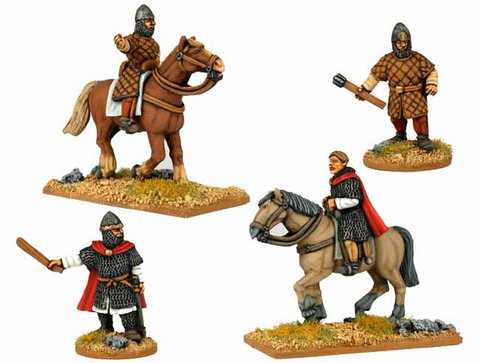

From Crusader Miniature's website, William and Odo


For SAGA, Odo can only lead a Norman warband and may not employ any swords for hire.

Hero of the Viking Age—As a Norman Lord, Odo generates 3 SAGA dice per turn instead of the usual 2 for most Warlords.

Bishop— As a lord bishop, Odo benefit's from the Lord's protection. During melee, Odo can discard Attack Dice in exchange for an equal number of Defense Dice, rather than half as is normal.

Greedy —On the other hand, Odo was quite rapacious, seeking every advantage possible. At the start of each turn, Odo can roll seven SAGA dice instead of six, assuming his warband can generate that many dice. 

Two of his abilities have been used before for other SAGA heroes, and the Bishop ability was created to emphasize Odo's "lead from the rear" approach.  It makes him hard to kill, but less offensive.

Monday, March 24, 2014

Harold Godwinson: The Fighting Man

In reading about Harold Godwinson, one of the more fascinating and frustrating details about Harold the warrior was his banner.  Fascinating, because of its reported design and beauty; frustrating, because no depiction or illustration of it exists.

According to the scant descriptions, it was an image of warrior embroidered on a cloth (red?...blue?) with gold and jewel ornamentation.  The Bayeux Tapestry does not depict it, showing only Harold's red dragon of Wessex.  The fate of the fighting man banner after Hastings is unknown.  Most likely, it fell with Harold on the hill and was taken by the Normans.  Some say that it was sent as a gift to the Pope Alexander II as thanks for lending William a papal banner for the invasion.  It could just as well have been squirreled away by survivors and lost to the ages.


The coloring was lifted from some reenactors because I thought the white on red was very striking for a scale reproduction. I made the banner by rolling out a piece of green stuff like a tiny pizza crust.  After it hardened, I trimmed it square, and sanded it with very fine (400 to 800) sandpaper.  I hand painted the fighting man with acrylics.


I finished the one on the right first, but was a bit unhappy with the lack of dynamics in the pose.  I then did the one on the left with the raised axe.  I still probably prefer the first figure, but I learned on the second one how to drape the green stuff before it hardened to simulate a billowing banner.  


A book on Anglo-Saxon art provided me with some figure inspiration, such as this piece of stonework from Shaftsbury.  

Next time, a look at the third contender for the English throne, Harald Hardrada.  
 

Tuesday, March 11, 2014

1066 Part 2: Harold Godwinson

The death of the childless Edward the Confessor in January of 1066 presented England with a crisis of succession.  Lacking any heir, the three rulers - Harald of Norway, the newly enthroned Harold of England and Duke William of Normandy - pursued their claims on the battlefield, with William emerging final victor... at least according to the oft told history.  In actuality, there was a perfectly legitimate blood heir to the throne, Edward's young grand-nephew Edgar. The reason why Edward did not become king and Harold did is largely a matter of his young age and the power of the Godwin family.

Harold's father Godwin was Sussex thegn of some, but not great importance in the time Ethelred the Unready, Godwin readily adapted to the conquest of the Dane King Cnut in 1016. By the time of Cnut's death in 1035, Godwin had become the powerful Earl of Wessex.  After brief reigns by two of Cnut's sons, the earls of England invited Ethelred's son Edward back from exile in Normandy to reign as king in 1042.  Edward chafed under Godwin's attempts to control him, and a dispute in 1051 led to the entire family's banishment from the kingdom.

Harold, the second son of Godwin was born in 1022, and already and earl in his own right at the time of his family's banishment in 1051. He went to Ireland, where he had friends and allies, which the Godwin's used to force their restoration the following year.

Following his father's death in 1053, Harold took on his role as the wielder of real power in England. As leader of the king's army, in 1062 and 1063 he decisively dealt with Welsh raiders by boldly marching into the Welsh lands.  Such was the pressure he placed on the Welsh, that Gruffud's own allies killed him and sent his head to Harold.  Less understood is the trip that he made to Normandy in either 1064 or 1065 (the sources are in dispute). Either by intention or accident a boat bearing Harold landed in Normandy and Harold became the unwilling guest of the Duke for a few months.  Harold's Normandy visit ended with a much debated incident in which the English earl swore fealty to William, supposedly upon some holy relics.

Immediately following Edward's death in 1065, the English witan - a council of Earls, met and conferred the crown on Harold.  It was done rather quickly, so much so that he was coronated even before Edward's burial.  Victorian era historians imagined the witan as a precursor to Parliament, with Anglo-Saxon England a proto-Constitutional monarchy, only to be corrupted by the autocratic despotism of the Normans. In reality, the exact function and role of the witan is rather confusing, and while rarely used it was mainly a tool of the richest and most powerful earls, in this case Harold.

However, Harold was probably the most capable ruler of all the claimants to the English throne.  He was literate and had progressive tendencies.  He put good governance ahead of family when the northern part of the realm rebelled against his brother Tostig's misrule.  He was well traveled and had diplomatic links as far as Rome and Russia.  As a commander, he defeated a variety of opponents including Norse, Welsh, and Bretons, sometimes in their own territory.  But a string of victories cannot make up for one staggering loss.  After holding together a larger, but tired and less disciplined army, against the Normans on the 12th of September 1066, Harold was felled in battle and his army routed.

Modelling Harold Godwinson

From the Bayeux Tapestry to later artistic representations, Harold is almost always represented as a physically impressive man, with brown hair and a mustache.  Gripping Beast and Crusader Miniatures both produce figures for Harold that adhere to this tradition. The two shots below are Crusader's Harold, based along with an axe bearing housecarl from Conquest Games.


Gripping Beast sells a pack of Harold with his brothers Gyrth and Leofwine, all three of whom were killed at Hastings.  This is the promo pic, which looks like a nice purchase.


Harold in Non-Fiction and Historical Fiction

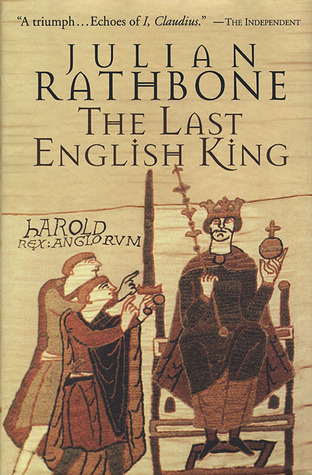
The previously recommended Last English King by Julian Rathbone is excellent, especially if one is looking for something a little more post-modern than straightforward action-adventure historical fiction. Set in 1070, it concerns a Frisian monk named Quint and his wanderings across Asia Minor with a crippled survivor of Hastings named Walt.  Quint slowly pries the story of Harold from Walt, and my favorite exchange between the two is this account of the battle:

     'A fighting man should stand on his own two feet and exchange blows with his adversary until one or other drops.  Besides, good horses are valuable, and can get killed in battle.  I saw three die between William the Bastard's thighs on Senlac Hill.  I could scare afford one horse, let alone three.'
     'But...'
     'If you are going to say they won because they fought from horses, forget it.'
     His face was suddenly suffused with angry blood again and Quint wisely chose not to pursue the subject.

If one wants to get an impression of the high regard that Victorian English held for Harold, a good place to look is G.A. Henty.  A tremendously popular Victorian writer, he is not well known today. That is a shame because Wulf the Saxon is an example of the "boy's own" genre that holds up to this day.  Like the previous book, the main character is a young Saxon, Wulf in this case, who has a fly on the wall perspective on the events leading up to Hastings and the aftermath.  As an added bonus, a free audio version is available at the public domain repository Librivox.

Most of my research on Harold comes from Harold: The Last Anglo-Saxon King by Ian W. Walker. It is a rare modern biography of Harold, and generous to his legacy.  Walker nicely balances the difference between a scholarly work and a popular history.  


Tuesday, February 18, 2014

Edward the Confessor

This is the first in a series of posts about the historical figures associated with the Norman invasion.  Historical information, miniature options, wargaming uses and historical fiction will be covered in this five (possibly six) part series.

King Edward the Confessor


While not a warrior or conqueror, Edward the Confessor was certainly a compelling figure in the eleventh century. The unique circumstances of his life and death led to the Norman invasion which is often rated as the most significant event in English history.  He was born c. 1003, the son of King Ethelred (the Unready) and Emma, daughter of Duke Richard of Normandy. After his father's death, Edward and his brother Alfred went to live in Normandy among his mother's relatives.  It was here that he developed an outlook on religious practice and organization that differed from his home country. Edward was finally invited to rule in 1042 after the death of his half brother Harthacanut.  He took the throne beholden to the powerful Godwin, Earl of Wessex, who years before had a role in the murder of Edward's brother, Alfred. Throughout his reign he tried to check the growing power of the earl and his numerous sons, but was apparently forced into a marriage with Godwin's young daughter Edith.  It was a childless marriage, the nature of which is still a source of speculation.  In 1051, conflict with the Godwins over appointments and the treatment of royal guests escalated to such a degree that the Earl and his sons were exiled from the kingdom.  Edward's triumph over the family was brief.  A year later, with Godwin and his men encamped in London and his own army wavering, Edward was forced to restore the family to their lands.  After Godwin's death in 1053, the aging Edward left more and more of the kingdom's administrative duties to Godwin's son Harold, but nonetheless encouraged his earls to strongly deal with threats from Scotland and Wales.

He died in January of 1066, and was buried in the still unfinished Westminster Abbey, a project that he had begun over twenty years earlier. He was eventually canonized, the only English king so honored.


Modeling Edward:

As far as my googling skills could turn up, no manufacturer markets an Edward the Confessor figure in 28mm (or any other scale).  Edward was often described as a tall, fit man with a prominent white beard.  The figure pictured above is an Anglo-Saxon king from Black Tree Designs. His guard is a mix of Gripping Beast metals and Conquest Games Normans with Dane axes. 

Use in SAGA:

Edward is not exactly a character that the average gamer is clamoring to play.  He was not a warrior, and England had little direct threat during his reign with occasional raids from her neighbors.  In fact, with little to fear from overseas invaders, Edward ordered much of his navy scrapped, lowering taxes in the process. However, with the three principal belligerents from 1066 (Harold, Harald and William) already depicted in SAGA, it is natural to find a place for Edward.

One could use generic Anglo-Saxon or Anglo-Dane king as Edward, and give him typical Warlord rules. For a more customizable character, I used two of the Charlemagne traits from The Raven's Shadow, along with a modified two SAGA dice rule. It should be acceptable in terms of game balance and if anything, Edward is nerfed a bit like my previous custom characters.

Elderly: Taking the throne at the advanced (Medieval) age of 40, Edward generates only 3 Attack Dice In combat, rather than the 5 usually granted to Warlords. He may not voluntarily engage the enemy in melee, and is not subject to the Warlord's Pride rule. He may not use the side by side rule.

Blessed: Although Edward only generates two SAGA Dice, his piety and devotion guide and reward him. Therefore, as long as he is on the table, one SAGA Dice can be re-rolled per turn.  This must be done during the Orders Phase.

Household: At the start of the game, one unit of four Housecarls may be designated as his royal guard.  The armour value of these household troops is increased to 6. Its role being that of the king’s bodyguard, if this unit starts the Activation Phase of its controlling player more than M away from Edward, it takes two FATIGUES.


PDF Download of Edward's Character Card

Suggested Reading (Historical Fiction)

The predominant view of Edward has long been that of a saintly and slightly withdrawn king who cared little for earthly matters, aside from hunting.  For a nuanced view of King Edward, check out Alfred Duggan's The Cunning of the Dove.  Decidedly pro-Norman and anti-Godwin, Duggan's pre-1066 England is withering under fractious rule by incompetent and jealous earls. King Edward is genuinely devout and celibate, who, as the book's title implies, subtly tried to insure that his successor will be one who will reform the church and centralize authority.

Edward the Confessor also plays a prominent role in Julian Rathbone's The Last English King.  Here he is not so celibate, in a not-that-there's-anything-wrong-with-that depiction. This Edward is also more petulant and selfish, and lacking the foresight to see the damage that his death will bring to England.  It's also a very thought provoking book about the basis of power and authority, along with some intentionally sly anachronisms. 

Up next will be a look at Edward's brother in law and immediate successor, Harold Godwinson.