Pages

Tuesday, September 22, 2015

Crusaders for SAGA & Frostgrave


Has it been over three months since I posted? I guess so. 

I have been busy over the summer, but not extraordinarily so: Some house renovations, camping with the kids and running a lot more, four or five days a week. 

The hobby has taken a bit of a backseat, but not entirely. I am painting a lot of fantasy figures lately and posting them on my other blog, Fantastically Small. I tend to compartmentalize, and this site is reserved for historical figures - from a pretty narrow slice of history at that. One reason for the slowdown in posting is that by and large, I've already completed most of my goals for Dark Age gaming. I've assembled rather large armies of Vikings, Normans, Scots and Irish. For Southern Europe, I have the Spanish, Moors and Byzantines. Sitting on the backburner is a Tibet v. Tang China project that I hope to get around to one day. 

Also, I need to game more often. I've yet to get in a proper Crescent and Cross scenario, but I'm eager to play the Crusader faction. Black Tree's Second Crusade line looked like a good starting point. 


In the Crusades, military units were a long way from having standardized colors and heraldry. But this is wargaming not history, and  I like thematic colors. I based my colors on the Jeremy Irons character from Kingdom of Heaven. He is supposed to be Raymond of Galilee, but called Tiberias, after his fortress. I recall reading that the filmmakers thought there were too many Raymonds in the movie and they didn't want to confuse viewers.   


A group of four knights and eight sergeants:


Historically, the early to mid twelfth century is a good period got building a Crusader Army. The Christian Levant kingdoms were still vigorous and the holy orders had just been founded. 

As mentioned, I'm tending more towards fantasy gaming more lately. Open Combat is still my favorite system for fantasy skirmishing. The recently released Frostgrave looked very promising and I'm giving it a try. My main reservation is that the campaign system seems very integral to the game. So if you are an occasional gamer without a circle of multiple gamer buddies, some of Frostgrave's best features are lost. 

Northstar's Frostgrave plastic boxed set is a good purchase. Some of the best faces I've seen, plastic or metal. Furthermore, there are plenty of accessories and options: bows, crossbows, hand weapons and two handed weapons and it is fairly compatible with Gripping Beast's plastics for all sorts of kit bashing potential. 


Historically, the helmets and headgear have in more with the Third Crusade through the  thirteenth century. Obviously they are outfitted for colder climates, so if you're wanting to do a Baltic Crusade for SAGA, this set and some Fireforge Teutonic knights will get you started. 

A wizard and apprentice with their mercenaries: 


These fantasy humans from Black Tree are equally good for a Hundred Years War Army.


Friday, June 19, 2015

MacBeth in film, drama and wargaming


MacBeth has been hovering at the edge of my awareness lately for several reasons.  Perhaps it is the upcoming movie with Fassbender, which seems to be as much influenced by Game of Thrones and TV's Vikings as by William Shakespeare.


MacBeth in History and Shakespeare 


MacBeth as history has taught us, was a Scottish lord, who received a prophecy from three witches that he would one day be King of Scotland. Slowly descending into madness, he murdered his king, and many others, friend and foe alike, at the urging of his power hungry wife. Shortly thereafter, he was killed by the rightful heir and an army of men wearing Dark Age ghillie suits.  

Right?...Not exactly, but it does speak to the power of Shakespeare in particular and literature in general to alter our perceptions of history.  In discussions I have had with Lit teachers, it is fair to say that a number of them take Shakespeare's plays for more or less accurate representations of events. Sure, Julius Caesar was really killed in a theater and not in the Senate, but the deed and perpetrators played out on stage as it did in reality. Similar discrepancies from history can be found in Antony and Cleopatra, the Henry cycle, but to suggest that MacBeth was a good king and hardly the murderous madman the Bard depicts goes against even their broadest interpretation of artistic license. 

MacBeth or Mac Bethad mac Findláich, was born in the early eleventh century. The monarch of Scotland through much of the period was Malcolm II, whose long reign was made possible by the strategic marriages of his several daughters to powerful families in Scotland and the Orkneys.  Some sources place Macbeth as being born from one of these marriages eventually elevating himself to be the lord of Moray. Thus, after Malcolm's death and the succession of his grandson Duncan to the throne, Macbeth found himself as a vassal to his cousin. For reasons not quite clear, Duncan invades Moray and was killed. Either because of his victory or his blood descent from Malcolm, MacBeth was elected High King in 1040. His reign was long and stable, enough that he was able to go on a pilgrimage to Rome in 1050. A few years late he was challenged by Duncan's son Malcolm, and the king met his death in battle in 1054. Malcolm did not become king immediately, for he had to kill MacBeth's stepson Lulach.  After accomplishing this task, Malcolm was installed as King Malcolm III.

Shakespeare's play The Tragedy of Macbeth premiered around 1606, a few years after the coronation of the Scottish King James. Not coincidentally, England's new monarch affected Shakespeare's writing in some very specific ways.  Obviously, the Scottish setting was the most important, so much so that superstitious actors sometimes refer to MacBeth as "The Scottish Play."  Furthermore, one of James' ancestors and MacBeth's victims is flatteringly depicted. 


Double, Double Toil and Trouble


The Witches of MacBeth by RAFM. The CD-base diorama was  mostly sculpted from Miliput and flocked.
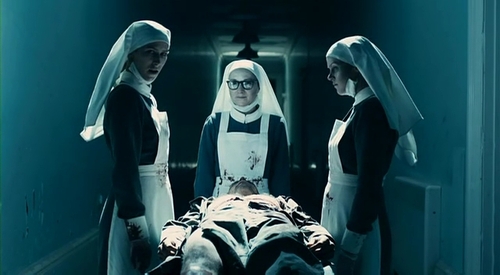
The most intriguing influence by King James on Shakespeare's MacBeth is inclusion of the three witches in the first scene. King James was fascinated by the study of witchcraft and he even wrote a text on identifying witches called Daemonologie. Shakespeare was certainly playing to the contemporary interest in witches when he made them a major part of his story. Highly recommended is the 2010 Patrick Stewart adaption of the play which modernizes the setting and show the three witches as hospital nurses. 


Macbeth - beyond Shakespeare


King Hereafter by Dorothy Dunnett - a book I try to re-read every couple of years.  It's massive in scope, and ambitiously proposes that MacBeth and Thorfinn of Orkney were not cousins, nor half-brothers, but the same person. It is not a literary gimmick, and the author genuinely believed it to be true based upon her interpretation of the various sources in her research. Thematically, the novel covers the end of the Viking Age, the decline of paganism and the incorporation of the northern European hinterlands into the realm of Christendom.

Macbeth the King, by Nigel Tranter - A straightforward historical account of Macbeth's rise and fall. Tranter is no great stylist or revisionist, but there is an efficiency in his prose and his prolific output is nothing to sneer at.

Macbeth in SAGA


The official mini for MacBeth is huge (over 32mm), as are most of the SAGA line's hero character. Below, a comparison shot with a Crusader mini (left) and a Reaper Barbarian.  The scale of most of Gripping Beast's Hero characters are more in line with current fantasy ranges. 


As a named hero, MacBeth is fairly typical in abilities, with little chance of game-breaking especially if paired off against another hero. 

Hero of the Viking Age. MacBeth generates three SAGA dice.  This is mandatory if I play a hero character. If I spend a point on a hero, I need the extra dice. I admit that I am not a skilled enough player to make use of special heroes who generate less dice, but have other abilities to compensate.

Norman Exiles. One unit of eight hearthguard can be mounted Norman knights. A number of these served in MacBeth when the Godwin's began to exert more control over the Norman favoring English king Edward. This is perhaps the earliest example of the Scottish-French alliance against their English rivals.

Great Ruler. As long as MacBeth is on the table, you always roll six SAGA dice. A great power, but doesn't it make his three SAGA dice ability irrelevant? Another minor ability in place of Hero would be better.

A six point Scot warband led by MacBeth:


Sunday, May 31, 2015

Nashcon 2015


I am a little late getting my pictures up from Nashcon on May 22nd.  I drove up early Saturday morning - it was only about a 2 1/2 hour drive.

The SAGA tournament was fun, but a little sparse in turnout.

My first match was Normans against Vikings.


Here my eight Sergeants crash into a unit of six Viking hearthguard...


And only one survivor per side...


The Normans took out the Viking warlord, buy my win was by just a few Victory points. My next match was against the Irish: 


It was a real education in how to use a battleboard.  MY opponent concentrated on making a single attack and stacking every possible effect into that attack. A single move wiped out entire units. 


These last few shots are of my warlord and his four remaining sergeants on a glory bound suicide attack. The game had went on too long, with a battle of attrition going against me.  Time to go out bold, I thought. 


And then the Irish warlord moves in, and of course through some strange mojo he places eight hits on me, or something like that... 


The real highlight of the day was an afternoon match in Alamo game run by Doc McBride of Splintered Light miniatures from his own rule set, Bloody Dawn. The rule set was  I played the Texans with two partners (pardners?).  It was funny being told before we began that we would lose and be killed to a man.  However, if we could take 600 Mexicans with us, that would satisfy the win conditions. 


After a short learning session, we took assigned roles.  I commanded the units at the main gate. Though in our game, most of the action took place at the North Wall.  


The Mexican team thinks arranging the dice pool into a flag will help their luck. 


Mexican forces take the wall, but are quickly routed with some timely hits on "6" and the special damages that occur. 


In the end, our Texans killed well over 600 before the enemy occupied the main plaza.  "Remember the Alamo!" 

This game was a first for me. Until now, I have never gamed anything in the 19th century, nor have I ever used 15mm.  It is definitely something I might be more interested in doing - however the experience of playing with the rules author on a massive custom table would be hard to match on my own. Maybe that's what cons are for. 


Bloody Dawn rules at Wargames Vault.


Wednesday, April 1, 2015

SAGA into Open Combat

Apologies for going a whole month without blogging. I have done my share of gaming and painting in the past month, but kid's birthdays, school sports and a return to running nearly eliminated my blog time. On the positive side, I can now build up a reserve of posts for times when I am crunched for time.


SAGA is my usual go-to historical skirmish game, but Open Combat is increasingly filling a niche: a quicker game, fewer figures, or games with newer players (like my young son).  SAGA is far quicker than most historical games, and its unit point system makes list building a matter of minutes.


On the other hand, Open Combat can be time consuming with its initial RPG-lite character creation, so I have been working on a few rules to convert SAGA figures into Open Combat.  As an “open” system, Open Combat can handle any self-imposed rules players choose to create.


First, to preserve SAGA’s units, the different quality troops will have assigned Fortitude and Renown points. These values will be apply across different factions. Warlords will not be assigned FOR points, as Warlords are meant to be more unique than other troops.


TROOP
TYPE
Renown
Fortitude
Levy
12
2
Warrior
18
3
Hearthguard
24
4
Warlord
30
-


Norman Archer (Levy) 

SPD
ATK
DEF
FOR
MIN
WPN
Abilities
3
2
2
2
1
Bow
Aim


For Warriors, the points go up by 6, giving them a Renown of 18.


Norman Spearman (warrior)

SPD
ATK
DEF
FOR
MIN
WPN
Abilities
3
3
3
3
2
Spear, Shield
Resolute, Shield Bash
The Warrior with a crossbow makes a formidable Dark Ages sniper:

Norman Crossbow (warrior)

SPD
ATK
DEF
FOR
MIN
WPN
Abilities
4
4
2
3
2
Crossbow
Marksman, Aim


The classic Norman troop is the mounted cavalryman. The Warlord, center, is flanked by two knights.


Norman Knights


SPD
ATK
DEF
FOR
MIN
WPN
Abilities
7
4
4
4
2
Lance, Shield
Furious Assault

Warlord


SPD
ATK
DEF
FOR
MIN
WPN
Abilities
8
5
4
5
3
Sword, Shield
Furious Assault, Inspire, Intimidate


To set your points for a match, begin with 30 for the Warlord, and add multiples of 24 to make purchasing easier.  The warband above is worth 198 points; 30 for the Warlord, 48 for four levy, 72 for four warriors and 48 for two knights. Finally, this is not meant to go against the ethos of Open Combat or "fix" it, but more as a way to show its adaptability to a variety of settings.

Up next, creating some foes for the Normans.


Wednesday, February 25, 2015

A Horse is a Horse

Last year, I purchased a shedload of Essex Arab and Tang Chinese figures from a webstore that was closing down.  A number of them were cavalry and unfortunately they were riders only - no horses. But at well under a dollar for a 28mm figure, I couldn't pass it up.  However, finding compatible horses has been a bit of a quest, but I like the hunt. Essex's would of course be perfect, but after rather high shipping costs and currency exchange, I was looking at about a $4 horse. Wanting to keep costs low, I looked at a variety of plastic sources.

HaT is a manufacturer of mostly 1/72 soft plastic figures.  I have a Macedonian and Persian army from them.  They are good figures, but no one seems to game ancients in that scale - it is either 15mm or 25/28mm.

HaT must have recognized this and has begun putting out a line of 28mm El Cid era figures. They still do not seem to have much of a grasp of the wargame market as their figures are upscaled from their 1/72 line.  Details like chainmail and faces are indistinct compared to any other plastic 28mm products on the market.  Most striking though, are the proportions. The HaT figures are more accurate, with a figure about 7 heads tall, whereas most 28mm figures run 5 or 6 heads tall.  This can make HaT's visually incompatible side by side - if that matters.  Because all I wanted were the horses, which don't seem to suffer from scaling issues, I bought a box:


Three identical sprues come in a box. The horses and riders are single piece models, in a hard, slightly glossy plastic. The horses are good, the riders are the weak point. 


On the other hand, they are inexpensive.  I can get a pack for under $16 at a "big box" hobby store, or pay a little more via the internet.  That's a decent price for 12 plastic 28mm figures - but are they worth it in terms of quality?

Below, here are some of the Essex heavy cavalry mounted on HaT horses.  All it took was a little shaving of the saddle and some file work on the rider.

Essex Arabs on HaT horses.

I was tempted to work on a unit using the included figures. I clipped off the original heads and glued a spare head from the Gripping Beast plastic Arab box.  Since the head is what are eyes are most drawn to, this conversion goes a long way to make these figures compatible with other 28mm lines. 


HaT Arabs with Gripping Beast heads

Below, a comparison of the converted HaT to similar models.

From left to right, Old Glory, the converted HaT, Gripping Beast and Artizan. 

The same horses for my Tang China cavalry


Overall, the HaT's are a good, but not ideal way to supplement your early Arab or Moor army. In light of the recent announcement from Gripping Beast that plastic Arab cavalry is coming in April, I am afraid these might not be so useful after all.