Pages

Wednesday, July 17, 2013

Good Fences Make Good Neighbors (Battlefield Obstacles)

My scenery project for the week was a couple of lengths of wattle fencing.  I experimented with several different materials.  I started by drilling some small holes in a strip of thick card and a strip of plastic.  I glued small craft sticks in the holes and wove the "wattle" material around the posts.

The fence in the foreground uses some packaging material from one my son's toys.  A few years ago, almost all packaged toys used plastic strips to secure the items inside.  The end result was a lot of extra plastic and parental frustration.  Lately, many companies have been switching to tying toys in with some sort of natural fiber material.  It is fairly thick, but wrapped easily around the posts and was held in place with white glue.  The fence in the background used sisal string as the wattle.  Again, weave it around the posts and coat heavily in white glue.


After the glue dried, I painted the pieces brown, dry brushed in highlights and added basing material: 


I almost ashamed to acknowledge the size of my painting backlog.  This particular item below is from Gripping Beast's baggage train.  My wife bought it for me last Christmas and I am just now getting to it.


The baggage train is a nice set, but a bit pricey for something that can be scratch built with a little effort.  You get two ponies, two carts and about a dozen barrels, bags and tools.  One cart is pulled by the animals, but the other is meant to be a fixed piece of scenery. Preferring mobility, I stumbled upon another use for Gripping Beast's plastic Dark Age Warriors - farmer.   


I wish I had painted him with a dark beard to look more like Topol so he could sing "If I Were a Rich Man."  One other conversion with these figures that I am curious about is making a longship rower out of one.  It would take a great deal of time and green stuff to make a small crew, but it would probably work.   


And finally this week, I finished my set of Conquest's Normans with this squad of mercenaries. Standardized shields and clothing were probably unheard of in the pre-heraldic era, but for a small group of swords for hire, it works on the table.  I think they will get some use in an upcoming Normans v. Welsh battle.    


Friday, July 5, 2013

Mixing Plastic Gripping Beast Parts

This is for Nico, who was wondering if the heads on the unarmored Gripping Beast Warriors were oversized.  If so, would a bare GB head look out of place on an armored body from the older sets?

I do not have a spare armored body to test this with, but it did happen that I am in the process of placing a spare head with a helm upon an unarmored body. I am also giving him a short fur cloak from a small piece of green stuff putty.


The head looks pretty good on the unarmored body and it is appropriate.  If a less elite warrior could only afford a single piece of armor, it is a good bet the helmet have been his first choice.

Here is a comparison shot below:

Comparison of Gripping Beasts' plastic heads
From left, two Vikings, two Dark Age warriors, and two Anglo-Saxons


The bald head is large, almost as large as the Viking helmets itself.  However, the Saxon helmets show that a head with a realistically encompassing helmet can look too big.  


Sunday, June 30, 2013

Not So Angry Monks

Not a great deal of figure painting this week - four monks, six slingers, a few Vikings - but I have got an interesting terrain project that I should finish soon.  It is a Spanish church based on San Pedro de La Nave. 

SAGA recently added Angry Monks as a sword for hire unit for Christian factions only.  They are basically a non shooting levy that generate SAGA dice if they are in close proximity to the Warlord. Additionally, when killed, they allow the controlling player to re-roll a spent SAGA die and place it on the table.

The Gripping Beast figures in the first two rows were painted a couple of years ago.  I recently added the four in the back from Black Tree's monks based on the Cadfael series. None of them are particularly angry looking, most are dour and a couple look menacingly stern.  Maybe they can make the raiders feel guilty.


The best use that I can imagine for Angry Monks would be to surround the Warlord and function as human shields.  However, since they are a levy, you cannot use them to take wounds for the Warlord under his special rules.  If you like to play unpredictably, the extra dice from your martyred monks could make for some wild situations, but I do not see them ending up on my game table as anything other than background for a scenario - maybe escort "baggage." If anyone can suggest a good tactical use for the monks, please let me know.

Cadfael is one of my favorite mystery series and I like these Black Tree figures.  They have nice proportions, expressive faces and are a bit taller than the Gripping Beast monks.  


Link to Studio Tomahawks PDF for Angry Monks

Here is a Shadowforge female Viking flanked by a Wargames Factory and Gripping Beast plastic figures.  I only have the single figure, so I based her as a Warlord.


Finally, I am now about half way finished with my forty plastic figures from the Gripping Beast Dark Age Warrior box.  The flexibility of these figures is such that with appropriate skin tones and fabrics, they can pass for anything from Vikings to Andalusian slingers.  I plan to put together about fifteen slingers from the set. 


Friday, June 21, 2013

Steppe Nomads for SAGA


SAGA's introduction of the Steppe Nomads into the recent expansion has opened up a number of figures I have acquired from my years of gaming with Byzantines.  While not as numerous as Vikings, Saxons and Normans, SAGA gamers can find a number of steppe figures that can fit into the early medieval period.

The Pechenegs 

The Khazars, probably a Turkic people, were for a time the dominant power on the southern Steppes in the early medieval period. In the ninth century, the nobility converted to Judaism, probably as a way of trying to balance relations with both the Christian Byzantines and the Islamic Abbasids. At the same time, they were dealing with territorial challenges from the Rus to their north and Pecheneg Turks migrating through their lands. The Pechenegs became something of a player or a pawn in the ambitions of the Rus, Khazars and Byzantines on the southern steppe.  Pechenegs in the service of the Byzantines killed Sviatoslav I of Kiev and, as typical of the times, turned his skull into a drinking goblet.

Old Glory's pack of Pechenegs has 10 figures in 5 poses.  Additionally, the bodies are in two pieces - an advantage for those wishing to convert or customize.  I found it to be too much work, with large gaps that needed filling.


Seljuq/Seljuk Turks

Another group of minor Turks that came to play a significant role in the history of the Middle East was the Seljuk Turks.  They migrated from the central Asian steppes through Khurasan and Persia, defeating the Ghaznvids.  They also formed the core of the Ghulams, heavy cavalry in service to the Abbasid caliph, where they exerted increasing control over the titular head of the (Sunni) Muslim world.

The Seljuq Empire on the eve of the First Crusade
photo from Wikipedia
Light Turkic cavalry, or Turcomans, carrying bows and short swords, employed the traditional steppe tactics of hit and run and feigned flight to wear down heavier armed enemies.  Magister Militum's Turcomans (below) are nicely designed and affordable, but a pack of twelve comes in only two poses, one male and one female.


Early Turkic warbands (prior to twelfth century) might have included female horse archers as well.  Accounts of female mounted warriors are well attested, stretching back to Herodotus' descriptions of the Scythians.


The Eastern Steppes

I have become interested in the similarity in the response between the Byzantine Empire and the medieval Chinese dynasties to incursions from the steppes.  Their strategies were similar in many ways.  For centuries, the two empires alternately favored one tribal group over another, while adapting and using mounted archers in their imperial forces. Similarly as well, it was finally a losing game, as the Turks eventually overwhelmed the Byzantines and the Mongols finally conquered Song China.  

The Jurchen were a Tungusic tribe dominated by the Khitan Liao Dynasty (907-1125). The Song Emperor made the mistake of favoring the Jurchens over the more settled Khitans.  After the Khitan's defeat by the Jurchens, they turned on the Song and seized the northern capital, imprisoning almost the entire Chinese royal family. 

These Jurchen figures are from Essex's extensive line of medieval Asian historicals. Expect to see more of these on a China/Asia SAGA mod that I am working on currently. 


The Mongols

Two new ranges of Mongols are forthcoming.  Fireforge is producing a set of plastic Mongols for their  Teutonic/Baltic range.  I think they are great looking, but the horses are a bit too large for Mongol steppe ponies.  Of course, if these are Golden Horde Mongols from the thirteenth century and on, they might have larger western horses. 


Gripping Beast's newletter also included a pic (below) of their new Mongol line.  While it is also intended as an opponent for their Teutonics, the smaller horse and less ornate detailing could allow its use in earlier settings.  


Monday, June 17, 2013

Battle Troll: Gameplay and Review


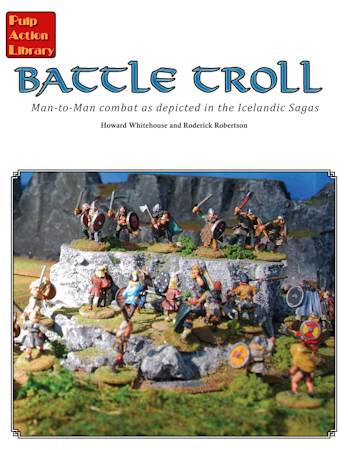
Battle Troll, by Pulp Action Library, is a Viking skirmish game that is most directly inspired by the Icelandic Sagas.  The authors, Howard Whitehouse and Roderick Robertson, set about to recreate the rivalries and blood feuds of early Icelandic history.  It was a tough and lawless environment, and with people living so close to the edge of survival, deadly feuds erupted over the inheritance of lands, lost livestock and arrangement of marriages.  While written with a great deal of humor, there is also a lot of research and respect for the sagas to be found.  After all, it includes as characters both the real life Leif Ericsson and an original named Gudrun the Slutty.  What's not to like?

To get started, one needs a rulebook, available from Wargames Vault or RPG Now as a printable pdf ($18) or a softcover edition ($24, including PDF), along with a set of cards as an extra purchase ($4 PDF/$8 printed).


The book is well organized and clearly written. Totaling 78 pages, the rules are contained in the first 24.  The remainder of the book is scenarios and campaign instructions, and it should not take more than two read-throughs to begin play. Production quality could be better.  There are lots of color photos of Viking minis, but the painting standard and photo quality do not holdup in comparison to the popular historical wargame rules on the market right now.

The gameplay is card driven with outcomes determined by dice rolls.  The two card decks are an Action deck, which determines initiative, and a Combat deck, which determines melee maneuvers.  Each player (up to 4) has a number of cards that can activate heroes, the warband or non-combatants. Another card is the End Turn card.  A random draw determines initiative, and I am always glad to see a variation on the IGYG system.


I found the Combat card melee to be the most interesting part of the game.  It is basically a rock-paper-scissors mechanic, with the attacker's and defender's cards determining the number of dice they roll against each other.  For example, if the attacker draws lunge, and the defender draws parry, the attacker gets one roll and the defender two.  A swing gets the attacker three dice, and the defender just one.  Other options include a jest, which does no damage, but can earn reputation points, and accidents.  If fighting with a hero character, the player can choose which attack or defense to use, but the cards are randomly drawn for lower level warriors.  

Nice line artwork on the back of the combat cards


Combat can be extremely detailed, with save rolls, hit location charts and differing armor effects.  Thankfully, these rules can be quickly streamlined to speed up gameplay.  I played a seven on seven match in just under 30 minutes.  Heroes are hard to kill in this game, especially if fighting inferior opponents.  Again, in the Icelandic Sagas, Gunnar supposedly killed more than a dozen enemies who ambushed him.  That's not likely to happen in a more realistic game system, but in the dramatized and larger than life world of Battle Troll, it is just possible.  

Another element that the game adds is Reputation Points, to mimic the importance of great feats in the Norse sagas.  Similar to victory points, Reputation can be won or lost in battle, or by delivering taunts at the enemy, and even dying a glorious death. 

To test the game, I put together a short scenario scenario involving 21 crew members of a Viing ship arguing over the division of a meager raid.  Seven warriors on each side: 1 hero, 3 hirdmen, and 3 bondi.  Also, seven men are undecided and sitting the fight out. They enter the fight under certain circumstances: if one side gets an advantage of more than 10 Reputation points, an undecided warrior joins that side.

The jarl and his men are in the lower left corner, the mutinous dogs/mistreated warriors are approaching from the right.  Those hedging their bets are waiting behind the tent to see who to support.


After doing very well at first, the jarl's men collapse upon his death and flee from the camp.


Final Analysis: With the campaign rules, and detailed individual combat, Battle Troll occupies territory between an RPG and a wargame, which is neither and advantage nor disadvantage from my point of view. It encourages banter and storytelling between players which is in keeping with the flavor of the period.  At the same time, Battle Troll has good potential for solo gamers with the random card element.  Finally, it is a bit pricey for what I expect to pay for a PDF, but if one were to compare the printed edition on a price per page basis to other rule systems, it still comes up cheaper.  Ultimately, you're paying for the rules and writing, not slick paper and pro photography. 

Saturday, June 8, 2013

My Kingdom for a Horse: By Arrow, Bill and Sword

Today, I ventured outside my narrow comfort zone of the early Medieval Era and into the late Medieval Era.

The models belong to a friend who is building a War of the Roses army from Perry Brothers metals and plastics.  I have never owned any Perry figures, but they live up to their reputation - well sculpted, nicely proportioned and excellent poses.

The rule set was By Arrow, Bill and Sword; a free skirmish level set put together by Silent Invader from the lead adventure forums.


Initiative and activation is determined by randomly dealt cards (visible in the background above).    We added a gameplay element not specifically present in the rules, in which we laid the activation cards face down behind each unit.  Players couldn't change the order of activation once a turn began, but the opponent did not know the order attack as well.  


Melee was a bit slow at first.  I thought it odd that a model's "to hit" number was the same no matter the quality of the attacker.  The advantage for superior troops, the captain and men at arms, was mainly defensive - better save dice numbers.  


Above: A mixed unit of York pike and longbow prepares to flank an advancing Lancaster line. 


Above: The battle ended when my billmen unhorsed and killed the York captain.  His whole band fails a morale check, handing victory to the Lancaster forces.  

The learning curve for the rules was very quick and adequately captured the flavor of the period.  They could probably easily work for late HYW or Hussite Wars as well.   As we were playing without cavalry units, I think another play through is in order in order to fully test the balance of troops.    

Arrow, Bill and Sword download link

Friday, June 7, 2013

Mega Miniatures and the future of metals

Over the years, I have picked up a few of Mega Miniature's models from ebay or the online store.  The nostalgia value of their line is high for me, reissuing many figures from my D & D days in the 80s.  While primarily catering to the role player, many of their townspeople and animals add character and possibilities to a skirmish scenario.

Sadly, the business will be no more by the end of the year.  As of May 31st, the molds are in the process of being sold off, and the store is set to close at the end of the year.  Hopefully most of the line will find homes elsewhere, but in how many different stores or sites?

Last year, I purchased a number of dancers and servants from Mega Mini's "Arabian Fantasy" line to use as background for my Spain campaigns.  I had the idea to build a small emir's palace for El Cid to lay siege.  All I have completed so far are the walls and this small plaza.  It is made from foam board, craft store tiles and Hirst Art blocks.

The dancers and serving girls below are typical of the Mega Mini's line.  On the short side of the 28mm scale, but not quite as small as a true 25mm, they also lack the sharp detail of most modern productions.


As a comparison, the dancer in green in the photo above is a metal Reaper figure.  The Reaper figure is excellent - sharp, nicely proportioned. It's not without its faults, though - look at those man hands!

Speaking of Reaper, the Reaper Bones Kickstarter may have been the writing on the wall for Mega Minis and other producers of inexpensive metals.  Converting a line of high quality metals into inexpensive plastics will dramatically change the RPG miniature market, if a $3 million dollar Kickstarter is any indication.  While it will probably have little effect on the historical wargaming market in the short term, the market will probably push many manufacturers to go plastic on even more of their lines and cancel models or whole periods that are not worth the conversion costs.