Pages

Showing posts with label Scots. Show all posts

Friday, June 19, 2015

MacBeth in film, drama and wargaming


MacBeth has been hovering at the edge of my awareness lately for several reasons.  Perhaps it is the upcoming movie with Fassbender, which seems to be as much influenced by Game of Thrones and TV's Vikings as by William Shakespeare.


MacBeth in History and Shakespeare 


MacBeth as history has taught us, was a Scottish lord, who received a prophecy from three witches that he would one day be King of Scotland. Slowly descending into madness, he murdered his king, and many others, friend and foe alike, at the urging of his power hungry wife. Shortly thereafter, he was killed by the rightful heir and an army of men wearing Dark Age ghillie suits.  

Right?...Not exactly, but it does speak to the power of Shakespeare in particular and literature in general to alter our perceptions of history.  In discussions I have had with Lit teachers, it is fair to say that a number of them take Shakespeare's plays for more or less accurate representations of events. Sure, Julius Caesar was really killed in a theater and not in the Senate, but the deed and perpetrators played out on stage as it did in reality. Similar discrepancies from history can be found in Antony and Cleopatra, the Henry cycle, but to suggest that MacBeth was a good king and hardly the murderous madman the Bard depicts goes against even their broadest interpretation of artistic license. 

MacBeth or Mac Bethad mac Findláich, was born in the early eleventh century. The monarch of Scotland through much of the period was Malcolm II, whose long reign was made possible by the strategic marriages of his several daughters to powerful families in Scotland and the Orkneys.  Some sources place Macbeth as being born from one of these marriages eventually elevating himself to be the lord of Moray. Thus, after Malcolm's death and the succession of his grandson Duncan to the throne, Macbeth found himself as a vassal to his cousin. For reasons not quite clear, Duncan invades Moray and was killed. Either because of his victory or his blood descent from Malcolm, MacBeth was elected High King in 1040. His reign was long and stable, enough that he was able to go on a pilgrimage to Rome in 1050. A few years late he was challenged by Duncan's son Malcolm, and the king met his death in battle in 1054. Malcolm did not become king immediately, for he had to kill MacBeth's stepson Lulach.  After accomplishing this task, Malcolm was installed as King Malcolm III.

Shakespeare's play The Tragedy of Macbeth premiered around 1606, a few years after the coronation of the Scottish King James. Not coincidentally, England's new monarch affected Shakespeare's writing in some very specific ways.  Obviously, the Scottish setting was the most important, so much so that superstitious actors sometimes refer to MacBeth as "The Scottish Play."  Furthermore, one of James' ancestors and MacBeth's victims is flatteringly depicted. 


Double, Double Toil and Trouble


The Witches of MacBeth by RAFM. The CD-base diorama was  mostly sculpted from Miliput and flocked.
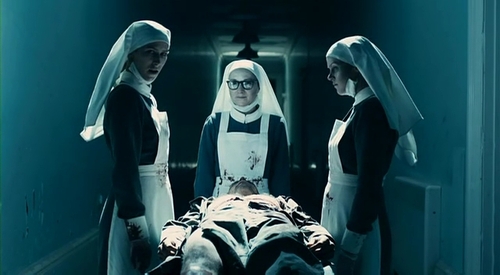
The most intriguing influence by King James on Shakespeare's MacBeth is inclusion of the three witches in the first scene. King James was fascinated by the study of witchcraft and he even wrote a text on identifying witches called Daemonologie. Shakespeare was certainly playing to the contemporary interest in witches when he made them a major part of his story. Highly recommended is the 2010 Patrick Stewart adaption of the play which modernizes the setting and show the three witches as hospital nurses. 


Macbeth - beyond Shakespeare


King Hereafter by Dorothy Dunnett - a book I try to re-read every couple of years.  It's massive in scope, and ambitiously proposes that MacBeth and Thorfinn of Orkney were not cousins, nor half-brothers, but the same person. It is not a literary gimmick, and the author genuinely believed it to be true based upon her interpretation of the various sources in her research. Thematically, the novel covers the end of the Viking Age, the decline of paganism and the incorporation of the northern European hinterlands into the realm of Christendom.

Macbeth the King, by Nigel Tranter - A straightforward historical account of Macbeth's rise and fall. Tranter is no great stylist or revisionist, but there is an efficiency in his prose and his prolific output is nothing to sneer at.

Macbeth in SAGA


The official mini for MacBeth is huge (over 32mm), as are most of the SAGA line's hero character. Below, a comparison shot with a Crusader mini (left) and a Reaper Barbarian.  The scale of most of Gripping Beast's Hero characters are more in line with current fantasy ranges. 


As a named hero, MacBeth is fairly typical in abilities, with little chance of game-breaking especially if paired off against another hero. 

Hero of the Viking Age. MacBeth generates three SAGA dice.  This is mandatory if I play a hero character. If I spend a point on a hero, I need the extra dice. I admit that I am not a skilled enough player to make use of special heroes who generate less dice, but have other abilities to compensate.

Norman Exiles. One unit of eight hearthguard can be mounted Norman knights. A number of these served in MacBeth when the Godwin's began to exert more control over the Norman favoring English king Edward. This is perhaps the earliest example of the Scottish-French alliance against their English rivals.

Great Ruler. As long as MacBeth is on the table, you always roll six SAGA dice. A great power, but doesn't it make his three SAGA dice ability irrelevant? Another minor ability in place of Hero would be better.

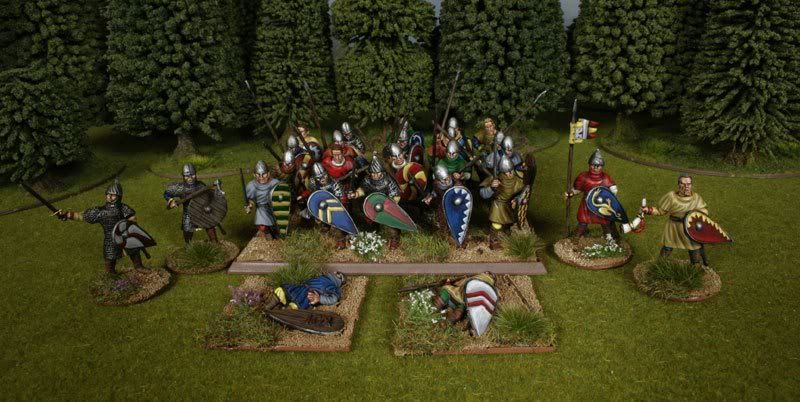
A six point Scot warband led by MacBeth:


Tuesday, February 10, 2015

February Painting Update - Finns, Irish and Scots

No historical content this week, but a few pictures of my painting efforts these past couple of weeks.

More Dark Age Finns, this time some Black Tree Design unarmored Bondi:


Also from Black Tree, some skirmishers with Javelin.  I kept them nondescript enough to use anywhere from the Byzantines to Ireland.  


Four Irish mounted fianna from Gripping Beast: 


Finally, mounted Scot warriors from Crusader Miniatures:  


Surprisingly, these were my only disappointment.  Usually, Crusader is my favorite manufacturer, but these were a bit of a let down.  Part of is my fault for mistakenly ordering the wrong pack (I wanted the Thegns with chain mail) but I was also a bit disappointed in the casting quality.  The horses were fine, but the men had excessive flash, and the faces are "muddied." 


Saturday, May 31, 2014

A Scottish Interlude

With a couple of SAGA games planned for this week, I needed to finish out my four points of Scots into a proper six point warband. All that was necessary was a warlord and a unit of Mounted Thanes that had been in my unpainted box for far too long. And after finishing about 20 plastic Arabs, I needed a little something different to paint.

Below, a Warlord stand and Standard Bearer.  Minis from Crusader, banner from Little Big Man.


My only complaint about Crusader Miniatures is that their cavalry is sold in threes, making a blister pack one short for a SAGA unit.  I'll probably throw in a Strathclyde Welsh to fill the unit out.  Below, the finished warband - three points of Thanes (one mounted), two Soer-chele and one Doer-chele.


Finally, if anyone is also interested in fantasy miniatures, I will be posting pictures of my efforts in that genre on a new blog Fantastically Small.  My two oldest children (ages five and nine) enjoy pushing fantasy figures around a table to the Song of Blades and Heroes rules, and I have enjoyed putting together and painting random figures that strike our interest. Thanks! 

Sunday, February 16, 2014

Game Report: A Feast of Crows

This week, I met up with a SAGA gamer through the Studio Tomahawk forum who lives relatively close to me.  For those who live in a game store laden metropolitan area, "close" means someone who shares this rather obscure hobby within an hour's drive.

With three people playing, we went for the Feast of Crows scenario, slightly modifying the starting deployment. I fielded my Scots, my first time playing the faction, while my two opponents went with the Normans and the Welsh.  If one wants to be historical, its an encounter that could take place in Northumbria in the 1070s or 1080s, as the Normans pushed the boundaries of their English conquests.


Above, after the first turn, my Scots move into cover with Normans to the left and Welsh to the right.


The first encounter takes place between the Normans and Welsh, as a group of Sergeants get pelted by Welsh javelins.  


On the other side of the field, Norman knights take a hit from the Scot Levy javelins as they bear down on a unit of Thanes.


The Thanes were wiped out by the Knights, with me losing three of the Scots for two Knights.  Above, I pull up a unit of Soer-Chele to assist the levy. 


The Scot Warlord and Thanes turn back the Welsh Warlord and mounted Teulu without a single loss. 


The Norman player's collection of defeated models, winning with the most victory points. My quick after-analysis says that Norman win was because the player took advantage of their two strengths - they are "shooty" and heavily armored. I like the Normans for the same reason. Despite my second place finish, I feel good about the Scots and plan to use them again, but perhaps with a bow levy instead of a javelin levy.  They are very defensive, which suits my play style very well, but with some nasty abilities such as Hold the Ground and Give Ground, both very devastating if used correctly.  

Thanks to The Battlegrounds in Dalton, Georgia for letting us use their space.  I am sure we looked odd amongst the Yugioh and Magic players, but their stock of board games and RPGs was top notch. Their racks of vintage NES, Sega and Playstation games was temptingly nostalgic, and I plan to pick some up the next time I am in there.  I look forward to more battles with my new friend, and possibly converting some of the curious teens who wandered over to our table into wargamers. 


Monday, December 3, 2012

Scots

A small confession on the advent of the SAGA expansion, Raven's Shadow - I have not yet played any of the factions from the last expansion, Northern Fury.  When I got back into gaming after a long absence, I filled my shelves with Vikings and Saxons (thank you, Bernard Cornwell).  An itch for Normans hit me after buying SAGA and reading some Jack Ludlow.  After turning some Wargames Factory Ancient Germans into Welsh, I have ended up with at least 6 points of all four original factions.

Then came the Jomsvikings, Anglo-Saxons, Bretons and Scots.  Obviously, the first three are analogous to original factions, with some differences.  The Jomsviking wrath mechanic was interesting, but gimmicky.  The Anglo-Saxon battleboard, with bonuses for large units, does not suit my style of play and the Bretons...liked them, painted a unit of skirmishers, and have every intention of getting them on the table.  Which brings me to the Scots.  The Scots battleboard is intriguing, and seems to demand a bit more forethought and strategic positioning of your forces.  Hopefully, my game next weekend can be a four point match up, with two hearthguards and two warriors.


Above and below, Thanes by Crusader Miniatures


Scots warriors


I was not able to find any conclusive or well documented depiction of pre-heraldic Scottish shield designs on the net.  So I went with vaguely Viking designs with some Celtic influence, borrowing liberally from a few other blogging wargamers.  

Reading Suggestions:

Clarkson, Tim, The Makers of Scotland: Picts, Romans, Gaels and Vikings. A highly readable look at the evolution of Scotland from pre-Roman times until roughly the year 1000.  The first third of the book suffers a bit from the authors attempt to weigh primary sources and chronicles, and ends up focusing on royal names and succession, rather than on the peoples and cultures promised in the title.  After working through this, Clarkson ends up delivering some valuable information about the development of the Scots, culturally and politically.  As a further inticement to SAGA players, the the forthcoming faction the Strathclyde Welsh also play a prominent role.

Dunnett, Dorothy, King Hereafter. Previously recommended, a historical novel in which Dunnett proposes that Macbeth and Thorfinn of Orkney were not cousins (or half-brothers) but one in the same.


Thursday, July 26, 2012

Printing and Finishing Custom Dice


My previous homebrew SAGA dice have been printed on decal paper or on regular paper and affixed with spray adhesive.  I am now working on something a little more professional looking, waterslide decals.  This paper can be obtained fairly reasonably from a variety of sources, I found mine on eBay years ago for a guitar related project. At any rate, I have about a dozen sheets left, great for a variety of uses.

I create my custom pictures using a freeware program calked PhotoFiltre, or use the image files on the Studio Tomahawk forum.  The SAGA community should be really thankful that the game designers have opened so much of the game up to fan experimentation.


I tried to put as many decals as I could on a page.  The decal paper is not very expensive, but I hate to waste space, and I could always make extra dice for friends I am trying to hook on SAGA.

Spray the printed sheet with a glossy sealer, let dry for several hours.

Carefully clip and dip your decals in a cup of water for about 30 seconds.  You want the decal to slide off the paper and onto the surface of the die. Too much submersion and most of the adhesive is leached away, too little and the decal will not come loose from the backing.


SAGA Dice for Woodland Indians or "Skraelings"


Finally, I sprayed the gloss sealer on the dice, a couple of coats to get all the sides.  All together, it is not terribly expensive to produce a set of dice this way, but it is time consuming.  Of course, one could always use regular d6, but without getting too pretentious, part of the appeal of rolling dice in general and SAGA dice in particular is its connection to ancient ritual behavior.  The earliest dice to prehistoric and ancient men were "knucklebones," or the anklebones of livestock or hoofed game like deer.  Symbols and runes were marked on the sides for use in shamanistic rituals...or mostly gambling.  Symbol dice seem to carry greater significance than just a number of dots.   

SAGA dice for the Scots faction


Wednesday, July 18, 2012

Time to Focus

Like most miniature collectors and games, I have a mountain of figures that seems to grow faster than I can paint it.  Currently, my unfinished projects are...

1. Some stray Norman and Byzantine infantry for SAGA:


2. The 37 figure Skraeling set for SAGA:


3. 16 Scot warriors from Crusader Miniatures purchased on impulse when I was reading King Hereafter months ago:


4. A few units of Song Chinese ordered from The Assault Group. I would like to do some skirmishing on China's western frontier with Chinese, Tibetans and steppe nomads.

Add to that the soon to be released plastic Norman infantry from Conquest Games - two boxes, definitely.