Pages

Showing posts with label Historical fiction. Show all posts

Tuesday, March 11, 2014

1066 Part 2: Harold Godwinson

The death of the childless Edward the Confessor in January of 1066 presented England with a crisis of succession.  Lacking any heir, the three rulers - Harald of Norway, the newly enthroned Harold of England and Duke William of Normandy - pursued their claims on the battlefield, with William emerging final victor... at least according to the oft told history.  In actuality, there was a perfectly legitimate blood heir to the throne, Edward's young grand-nephew Edgar. The reason why Edward did not become king and Harold did is largely a matter of his young age and the power of the Godwin family.

Harold's father Godwin was Sussex thegn of some, but not great importance in the time Ethelred the Unready, Godwin readily adapted to the conquest of the Dane King Cnut in 1016. By the time of Cnut's death in 1035, Godwin had become the powerful Earl of Wessex.  After brief reigns by two of Cnut's sons, the earls of England invited Ethelred's son Edward back from exile in Normandy to reign as king in 1042.  Edward chafed under Godwin's attempts to control him, and a dispute in 1051 led to the entire family's banishment from the kingdom.

Harold, the second son of Godwin was born in 1022, and already and earl in his own right at the time of his family's banishment in 1051. He went to Ireland, where he had friends and allies, which the Godwin's used to force their restoration the following year.

Following his father's death in 1053, Harold took on his role as the wielder of real power in England. As leader of the king's army, in 1062 and 1063 he decisively dealt with Welsh raiders by boldly marching into the Welsh lands.  Such was the pressure he placed on the Welsh, that Gruffud's own allies killed him and sent his head to Harold.  Less understood is the trip that he made to Normandy in either 1064 or 1065 (the sources are in dispute). Either by intention or accident a boat bearing Harold landed in Normandy and Harold became the unwilling guest of the Duke for a few months.  Harold's Normandy visit ended with a much debated incident in which the English earl swore fealty to William, supposedly upon some holy relics.

Immediately following Edward's death in 1065, the English witan - a council of Earls, met and conferred the crown on Harold.  It was done rather quickly, so much so that he was coronated even before Edward's burial.  Victorian era historians imagined the witan as a precursor to Parliament, with Anglo-Saxon England a proto-Constitutional monarchy, only to be corrupted by the autocratic despotism of the Normans. In reality, the exact function and role of the witan is rather confusing, and while rarely used it was mainly a tool of the richest and most powerful earls, in this case Harold.

However, Harold was probably the most capable ruler of all the claimants to the English throne.  He was literate and had progressive tendencies.  He put good governance ahead of family when the northern part of the realm rebelled against his brother Tostig's misrule.  He was well traveled and had diplomatic links as far as Rome and Russia.  As a commander, he defeated a variety of opponents including Norse, Welsh, and Bretons, sometimes in their own territory.  But a string of victories cannot make up for one staggering loss.  After holding together a larger, but tired and less disciplined army, against the Normans on the 12th of September 1066, Harold was felled in battle and his army routed.

Modelling Harold Godwinson

From the Bayeux Tapestry to later artistic representations, Harold is almost always represented as a physically impressive man, with brown hair and a mustache.  Gripping Beast and Crusader Miniatures both produce figures for Harold that adhere to this tradition. The two shots below are Crusader's Harold, based along with an axe bearing housecarl from Conquest Games.


Gripping Beast sells a pack of Harold with his brothers Gyrth and Leofwine, all three of whom were killed at Hastings.  This is the promo pic, which looks like a nice purchase.


Harold in Non-Fiction and Historical Fiction
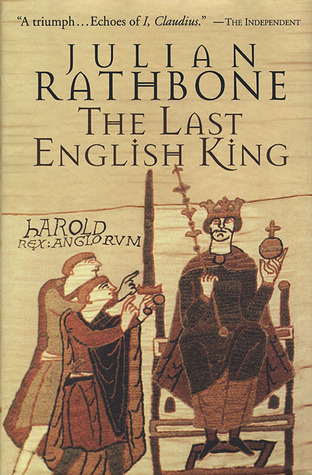
The previously recommended Last English King by Julian Rathbone is excellent, especially if one is looking for something a little more post-modern than straightforward action-adventure historical fiction. Set in 1070, it concerns a Frisian monk named Quint and his wanderings across Asia Minor with a crippled survivor of Hastings named Walt.  Quint slowly pries the story of Harold from Walt, and my favorite exchange between the two is this account of the battle:

     'A fighting man should stand on his own two feet and exchange blows with his adversary until one or other drops.  Besides, good horses are valuable, and can get killed in battle.  I saw three die between William the Bastard's thighs on Senlac Hill.  I could scare afford one horse, let alone three.'
     'But...'
     'If you are going to say they won because they fought from horses, forget it.'
     His face was suddenly suffused with angry blood again and Quint wisely chose not to pursue the subject.

If one wants to get an impression of the high regard that Victorian English held for Harold, a good place to look is G.A. Henty.  A tremendously popular Victorian writer, he is not well known today. That is a shame because Wulf the Saxon is an example of the "boy's own" genre that holds up to this day.  Like the previous book, the main character is a young Saxon, Wulf in this case, who has a fly on the wall perspective on the events leading up to Hastings and the aftermath.  As an added bonus, a free audio version is available at the public domain repository Librivox.

Most of my research on Harold comes from Harold: The Last Anglo-Saxon King by Ian W. Walker. It is a rare modern biography of Harold, and generous to his legacy.  Walker nicely balances the difference between a scholarly work and a popular history.  


Tuesday, January 7, 2014

Gruffud ap Cynan

Over the Christmas break I read several books that had been on my to-do list, but the one that I enjoyed the most was a last minute impulse-buy from a young self published author.  Caveat emptor is the general rule when it comes to self published Kindle books, but Ethan Jones' Birthright is worth your attention. From my Amazon review:

Wales in the late eleventh century was dangerous territory. A generally poor land divided into three kingdoms, it was nonetheless caught up in the machinations between Normans, Irish, Norse Gaels and its own rival rulers. Into this came the young Welsh prince Gruffud ap Cynan seeking to reclaim his kingdom of Gwynned from evil usurpers - at least, that's how he sees it.  Jones should be commended for plucking Gruffud from history and into the pages of his first novel.  As the author depicts him, Gruffud is not an invincible medieval superman (I am looking at you Uhtred).  He is a powerful warrior and bright for his age, but impetuous and diplomatically naive.

Jones can write a vivid and bloody battle.  The violence is Homeresque in its detail: limbs are severed, teeth shatter, noses are rent from faces.  The beatdown one of Gruffud's allies administers to an enemy is so brutal and sickeningly described that even our hero looks away in disgust.  The characters, while mostly all warriors, are well shaded with different motivations and attitudes. The plot does follow many of the conventions and expectations of historical fictions, but I do not necessarily blame Jones for this predictability.  Gruffud's life was one of almost constant battle and intrigue, the basic material for this genre - but do yourself a favor and do not wikipedia him until after you have read this book.  One convention of historical fiction I would have liked to have seen included was a map of Wales in this era with the novel's locations marked.

Highly satisfying, and I will be back for more when Mr. Jones brings us the next volume in Gruffud's life.


For wargamers, especially players of SAGA, there is a lot to enjoy. Battles are generally skirmishes, with Gruffud taking an active and leading role.  The differences in unit names, weapons and fighting styles of the Welsh, Norse and Normans are described in terms that button-counting wargamers will appreciate.

So the following is my interpretation of Gruffud for SAGA based in part on history and on Ethan Jones' depiction in Birthright. 

Gruffud ap Cynan, Rightful king of Gwynned


Gruffud, with the Lion of the House of Aberffraw on his shield.
Figure: Gripping Beast's Norse-Gael Warlord


Across Britain  in the eleventh century, alliances and territory shifted with an alarming frequency between Saxon, Viking and Welsh peoples. The arrival of the Normans on the Welsh Marches brought further strife to the region.

Into this world was born Gruffud, heir to the House of Aberffaw, claimant of the Welsh kingdom of Gwynned.  Through his mother, Gruffud was a grandson of Sigtrygg Silkbeard of the Hiberno-Norse rulers of Dublin.  It was there that he was raised following his family's ousting from Gwynned when he was a child. Supported by loyal Welsh, along with Irish allies, he set out in 1072 to reclaim his birthright.

His hold on the throne lost and regained more than once. Later in his life, he was held captive by the Normans for at least a decade until his escape.  Ultimately, he beat the odds and died an old man, King of Gwynedd.


Something to Prove—As a Hero of the Viking Age, Gruffud generates 3 SAGA dice per turn but only if he is the first unit on his side to engage in melee.  Otherwise, Gruffud will only generate 2 SAGA dice per turn. Note: the player will begin a game with three dice for Gruffud and keep them as long as the above conditions are met.

Mixed Ancestry —As his mother was a granddaughter of Sigtrygg Silkbeard, Gruffud can call on support from his Welsh or Norse Gael allies.  At the start of each turn, you may choose what mix of SAGA dice to roll between the Welsh and Viking Dice.  Viking dice may only be used on the Norse-Gael Battle Board and the Welsh Dice may only be used on the Welsh Battle Board.

Resourceful — unlike other Heroes of the Viking Age, Gruffud can call upon Swords for Hire units the Gall-Gaedhil or Flemish mercenaries.


Let me know if you have any suggestions on improving his stats.  I play tested it in a couple of short turn sequences.  The use of two Battleboards is interesting and based on Cnut, but he is intentionally less powerful than your average Hero.  After all, the historical Gruffud was marginally successful, but definitely not on the order of William of Normandy or Charlemagne!

Open a PDF of Gruffud's battle card
Update: I just fixed the link so that it can be opened without a request, sorry!

Birthright on the US Kindle Store

Tuesday, October 15, 2013

The Byzantines are Back in Town

When life happens, blogging doesn't.  Honestly though, a month off from the blog does not mean I abandoned the hobby.  So while I was a bit busier with job and family commitments, I have painted a few units and almost finished a fairly massive terrain piece that I will post later this week. In gaming, I played some SAGA and Song of Blades and Heroes, and ordered the Hail Caesar rule book when I caught it on sale on Amazon for 34% off.

In the meantime, I am trying to build up a couple of my skirmish armies into the sizes necessary for more massive battles, starting with the Byzantines and Normans.

Below, are Crusader Miniatures' Byzantine Kataphractoi with spears and maces.  The troops are nicely posed and detailed, but my one critique is that the armored horses had far more flash on the rear legs than on Crusader's other horses.  Whether I got a bad batch, or if its typical of the bulkier barded horses, I cannot say.


Next, are some shots of armored skutatoi and archers.  The variations on leather and chainmail armor kept the painting process interesting, while still maintaining visual cohesion.  Admittedly, Byzantines are a bit of a challenge, as I am more accustomed to painting generic Dark Age Vikings, Saxons and Normans.  Someone coming at them from a Roman Imperial direction would find it standard practice.


Historical Fiction Recommendation

I am not sure if anyone else in the hobby has this compulsion, but I like to read what I am painting.  While painting the Byzantine Cavalry, I read some fiction and non-fiction set in the Byzantine Empire, mostly some Osprey titles, but also this new discovery:


I found Strategos: Born in the Borderlands and Rise of the Golden Heart by Gordon Doherty through a Goodreads group.  The two released books of a trilogy tell the story of Apion, an orphaned Byzantine raised by a Seljuk farmer in eleventh century Anatolia.  From a childhood in slavery, he rises to a commander in the Byzantine army in the years leading up to the Battle of Manzikert. Doherty writes compelling battle scenes and builds the air of conspiracy and danger that gave the alternate meaning to the word Byzantine.  On equipment and tactics, the novels are well researched, but he makes some assumptions about the organization and activity of Byzantine thematic armies that I have not read elsewhere.  It is nothing disruptive to the plot, but it did pull me out of the narrative occasionally as I wondered if it was history or invention.   He also admittedly invents the shadowy enemy pursued by the main character, but it is based on an earlier Roman imperial practice.  Both books are available on Kindle.

Strategos: Born in the Borderlands


Tuesday, April 23, 2013

Spanish History and Historical Fiction for Wargamers

As I continue on with my Spanish projects, I thought I would share my reading material since January.

Non-Fiction:

Barton, Simon and Richard Fletcher. The World of El Cid: Chronicles of the Spanish Reconquista. Manchester University Press, 2001.

For the student of Spanish history who wants to read primary sources in English, this is the best work.  While not modestly priced, it is not as expensive as learning Latin, Arabic or medieval Spanish. Works best after reading a more general history such as Fletcher's The Quest for El Cid.

Fletcher, Richard. The Quest for El Cid. Oxford University Press: 1991.

Not so much a biography of El Cid as it is a survey or what we know and do not know about the legendary Castilian warrior.  Fletcher spends almost the first half of the book on an overview of Spain from Visgothic times until the eleventh century, but it is time well spent. When he arrives at the Cid's story, the reader understands the political and social forces that turned the tide on Islamic Spain in the eleventh century.  

Lowney, Chris. A Vanished World: Medieval Spain's Golden Age Christians, Muslims and Jews

As a general rule, I tend to be suspicious of popular histories that announce their thesis in the title (i.e. how so and so changed the world), and this does not prove to be an exception to that rule. Written looking backwards with 9/11 and the Madrid bombings as a starting point, wistfully (or is that wishfully?) recalls a golden age of cooperation and coexistance in medieval Iberia. On the positive side, the chapters are thematically organized around a series of unique individuals or events that are barely covered in the more general chronological histories of the Reconquista. 
Nicolle, David. El Cid and the Reconquista 1050 - 1492. Osprey: 1988.
Nicolle, David. The Moors: The Islamic West 7th - 15th Centuries AD. Osprey: 2001.

Both of Osprey's two entries on the subject of Medieval Spain were written by David Nicolle and illustrated by the superb Angus McBride. Unfortunately, both books cover such a vast expanse of time that the amount of material, literary and artistic, devoted to the El Cid era is less than I hoped for.  Essential for the wargamer, nonetheless. 

Reilly, Bernard. The Kingdom of Leon-Castilla Under King Alfonso VI 1065-1109. University of Pennsylvania Press: 1988.  Available online at http://libro.uca.edu/alfonso6/alfonso.htm

Essential reading for the important transitional rule of Alfonso VI.  After King Ferdinand I engineered the unification of most of the Christian lands of the north, he left them divided among his sons at his death.  The middle son, Alfonso, reunified the lands at the cost of his own brother's lives.  While deeply appreciative of Andalusian culture, Alfonso VI was also closely associated with deeply pious and Cluniac clergy.  The Kingdom of Leon-Castilla Under King Alfonso VI 1065-1109 details how Alfonso built upon his father's political and military institutions and decisively turned the tide of the Spanish Reconquista in favor of the Christians.  This is academic reading, but accessible, both in terms of writing and price - it is freely available online as a pdf. 

The Poem of the Cid: Dual Language Edition. Penguin Classics: 1985.
Anyone familiar with the Viking sagas will recognize the epic qualities of The Poem of the Cid, or the Lay of the Cid as it is also known.  There is history here, to be sure, but also a healthy dose of myth making...not that there is anything wrong with that.  

Fiction:

Kay, Guy Gavriel. The Lions of al-Rassan. Harper: 1995.

Beautiful, tragic and evocative of a beautiful time and place that might have been.  Read all of Kay's books. Now. 

Reilly, Bernard. Journey to Compostela: A Novel of Medieval Pilgrimage and Peril. Combined Publishing: 2001.
Set in an unspecified year during the reign of Alfonso VI, a contest of wills develops between the two protagonists, one a peasant and the other a noble.  While very brief and quickly read, it is a good description of the class divide in the early feudal era.  For wargamers, it has a few action set pieces that could easily be turned into skirmishing scenarios.    

Monday, September 10, 2012

Norman Infantry and Recommended Reading

As I continue my work on my Conquest Norman Infantry, I am impressed with how useful they are in a variety of roles.


Here is a group of unarmored Normans set up as Breton skirmishers.  I shortened the spears to javelin length and added a few bare heads from other manufacturers.  


A unit of Normans 


Another option included in the box is a double handed axeman.  Paint him a mustache and you have an Anglo-Dane huscarl.


Non-Fiction:

Haskins, Charles Homer The Normans in European History.  Haskins deserves praise as one of the greatest medievalists of the early twentieth century, while he was less than successful as a close advisor to Woodrow Wilson at the Paris Peace Conference in 1919.  Although close to a hundred years old,  The Normans in European History is an excellent description of how the Normans evolved from Viking settlers (or extortionists of the Franks) into an organized medieval state in under two centuries.  Haskins' historical viewpoint is a product of his times, and he attempts somewhat unsuccessfully to view and define the duchy of Normandy in twentieth century nation-state terms. Available as a free ebook on Google Play and Amazon.com

O'Brien, Harriet Queen Emma and the Vikings. Popular history about a central, but often forgotten figure in the great game of pursuing the throne of England in the eleventh century.  Emma, a Norman princess, was married to two kings of England, Aethelred and Cnut, and mother to two as well, Harthacnut and Edward the Confessor, and finally, aunt to William the Bastard (Conqueror).

Fiction:

Duggan, Alfred. Knight in Armor. Finest piece of historical fiction on the Crusades that I have read.  The eponymous knight, a young Norman who joins the First Crusade, is not particularly likeable or intelligent.  Published in 1950, it rests both chronologically and spiritually between nineteenth century romanticism and late twentieth century revisionism.  The march across the Near East is shown as a bloody, sordid and mostly unholy affair, and yet the final few pages capture the elation, desperation and triumph of achieving such an unlikely conquest.

Duggan, Alfred. The Lady for Ransom.  This time Duggan follows a band of Italian Normans who become Byzantine mercenaries and are present as the empire fell apart in chaos after the Battle of Manzikert. If Duggan wrote a bad book, I have yet to come across it, and this is one of my favorites.

Ludlow, Jack - The Conquest Trilogy.  Ludlow's trilogy is comprised of Mercenaries, Warrior and Conquest and recounts the de Hauteville family's conquest of southern Italy. Obviously impressed with Norman military prowess, Ludlow begins book one with the practical eldest brother William Ironarm who sought his fortune in Italy as one of many Norman adventurers. The series finally finishes with the domination of Southern Italy by the youngest brother, Robert Guiscard. The dialogue is terse and efficient, and it captures the political and military machinations of the Normans, Lombards, Byzantines and the Papacy very well.  Stylistically however, Ludlow is dry and clinical, and almost never evocative, as the setting demands.  Having finished the series on audiobook, the excellent narration by Jonathon Keeble compensates for the lack of mood in the prose.


Sunday, August 19, 2012

Woodland Indians update

The Gripping Beast Skraeling army is almost completed - only a unit of warriors and the War Chief remain.  They will propbably put on hold, a box of plastic Normans awaits.


Non-Fiction Reading Recommendations


For further research on the Indians of the southeast, the best survey is Charles Hudson's The Southeastern Indians (1976).  It is a comprehensive look at the peoples of the southeast from the Paleolithic Era to the Cherokees.  The wargamer and military historian might better enjoy that same author's Knights of Spain, Warriors of the Sun (1997).  It is a well researched scholarly work about DeSoto's journey through the southeast, but its also a gripping narrative of the encounter between the Old and New Worlds at the end of the Middle Ages.  Centuries before, the steel swords of the Vikings were not enough to make colonization of the Americas tenable; later the guns, germs and steel of the Europeans made conquest almost inevitable.  However, in this brief moment, both sides faced each other with an equal share of advantages and disadvantages.  As DeSoto and his band haphazardly wandered across the south, they were also torn apart by their lust for gold and internal jealousies.

Historical Fiction 

People of the Weeping Eye
People of the Masks 


The First American series of books by Michael Gear and Kathleen O'Neal Gear can be an uneven lot.  Most books contain a liberal amount of New Age mysticism, but overall the authors avoid idealized depictions of harmonious first peoples.  They depict a complex, yet deeply tribal group of peoples, who build, destroy, scheme, love, fight, and trade.  It should also be noted that the authors engage in what fantasy writers would call world building.  No matter how archaeologically informed and researched, the authors do have to re-create the intricacies of social institutions without any documentation. In The People of the Weeping Eye warfare erupts as one tribe challenges the hegemony of another among the mound builders of Mississippi and Alabama.  For those interested in the Viking/Indian encounter, a more relevant book might be People of the Masks, about the early Iroquois, builders of the longhouses.

Tuesday, April 10, 2012

Norse Women and Gunnar's Daughter

  Painting civillians is fun, but their usefulness in gaming is limited.  I intend to build and photograph some diorama scenes but that keeps getting delayed behind a pile of unpainted metal and plastic.  Anyway, here's two of Gripping Beast's female civillians sculpted and painted in Norse style clothing, probably as wives of well-off farmers.


Mega Minatures on Ebay sells a line of fantasy townsfolk.  Here's two that are being drafted into service as female thralls on a Norse farm.


From Gripping Beast, a higher born Norse woman, perhaps the wife of a jarl:


And here she is with a servant tending to her child:


     Finding a story about women in the Viking age is difficult. To be sure, there are plenty of Viking romance novels to be found, but there is little in that market that seems to have much substance.  A rarity is Gunnar's Daughter, the first published work (1909) by the future nobel prize winner Sigrid Undset, who was then only 26 years old.


Gunnar's Daughter is a fictional companion piece to the Icelandic sagas. Those sagas in particular, show how minor insults and altercations could spin out of control and turn into bloody feuds.  The lives of farmers, important landowners and their servants are the focus rather than the kings and lords of the Norwegian sagas.  Written in a faux saga style, a enough common affectation now, but probably pioneering for its time, Undset's novel is a hauntingly simple story.  Set in early eleventh century Norway, the daughter of a well-off landowner is raped by a suitor, forever changing both of their lives.  A single violent act perpetuates further violence, culminating almost twenty years later.  

     Like the sagas it emulates, the prose is stark; the physical environment is not ponderously described, and the action and conflict progresses quickly. While it is stylistically similar to the sagas, the thematic differences outnumber the similarities.  Women feature prominently in a number of the Icelandic sagas, but the impact of violence against them is rarely a central concern as it is in Gunnar's Daughter.  Complex and  riveting, Undset illustrates the high cost of love, honor, revenge and faith.

Gripping Beast miniatures purchased from Architects of War.

Gunnar's Daughter at Amazon.com