Pictured is the only part of the fortress completed - a wall and tower. The tower is in two sections, and the dividing point is easily seen above the door. My plan is to just add one more wall and gate section and place it between a mountain pass and create various scenarios around that terrain.
Friday, June 22, 2012
Frontier Outpost
Tuesday, June 19, 2012
Horse Archers of the Byzantines
One of the inescapable conflicts from prehistory through the Medieval period was the struggle between settled peoples and nomads. Settled peoples with agriculture and government could produce larger armies with organization through hierarchy. They could also be poorly trained and overly centralized. Central Asian nomads, from the Scythians and Huns of Ancient times to the Mongols of the thirteenth centuries were skilled horse warriors Their lack of centralized statehood made them prone to fighting each other especially concerning the question of succession. Technology of the cities was not an advantage until gunpowder weapons became quick and dependable.
The Byzantine Empire of the tenth and eleventh centuries struggled with nomads, just as its counterpart in China, the Song Dynasty, was as well. Both empires arrived at the same solution, which was to play upon the natural rivalries of nomads by favoring one group over another, and then changing sides. This strategy did not work well in the long run for the Chinese, as nomadic rivals eliminated themselves leaving the Song Dynasty alone against the Mongols.
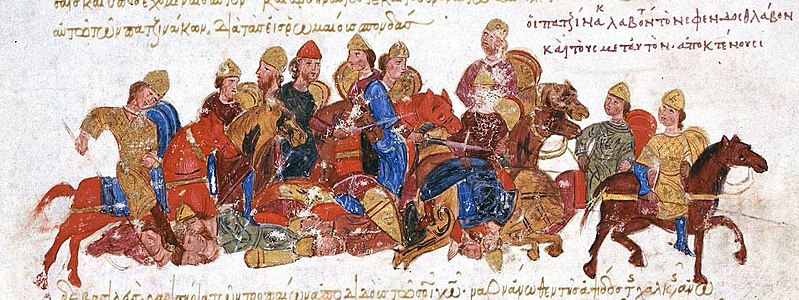
The Pechenegs were a Turkish people who moved into the Byzantine orbit on the southwestern Eurasian steppes in the ninth and tenth centuries. As part of the shifting alliances of that period, they fought against and with the Byzantines, Rus, Bulgarians and Hungarians. These 28mm figures are from Old Glory. I painted them in solid, but somewhat bright colors based on a depiction of their victory over Sviatoslav I of Kiev. Their figures are a good value, and while I wish the horses were a bit sharper, they represent the smaller but bulkier steppe horses better than most other manufacturers that I have seen.
| photo from Wikimedia Commons |
Militarily, Byzantine response to nomadic raiders was to incorporate missile cavalry into their own forces. A notable example was Tacitus, a Christian Turk (probably Pecheneg) who led a group of Byzantine horse archers accompanying the First Crusaders across Asia Minor.
The Byzantine Horse Archers are by Crusader, and are really well done. Their horses are some of the best, and the figures all show slight variations in dress, appropriate for light cavalry.
Reading Recommendation: The best explanation I have read on the role of gunpowder in the conflict between states and nomads is in Kenneth Chase's Firearms: A Global History to 1700. It is a near comprehensive look at how firearms changed warfare in China, Europe, the Middle East and Japan in the late Medieval and Early Modern periods.
Firearms: A Global History to 1700 at Amazon
Thursday, May 31, 2012
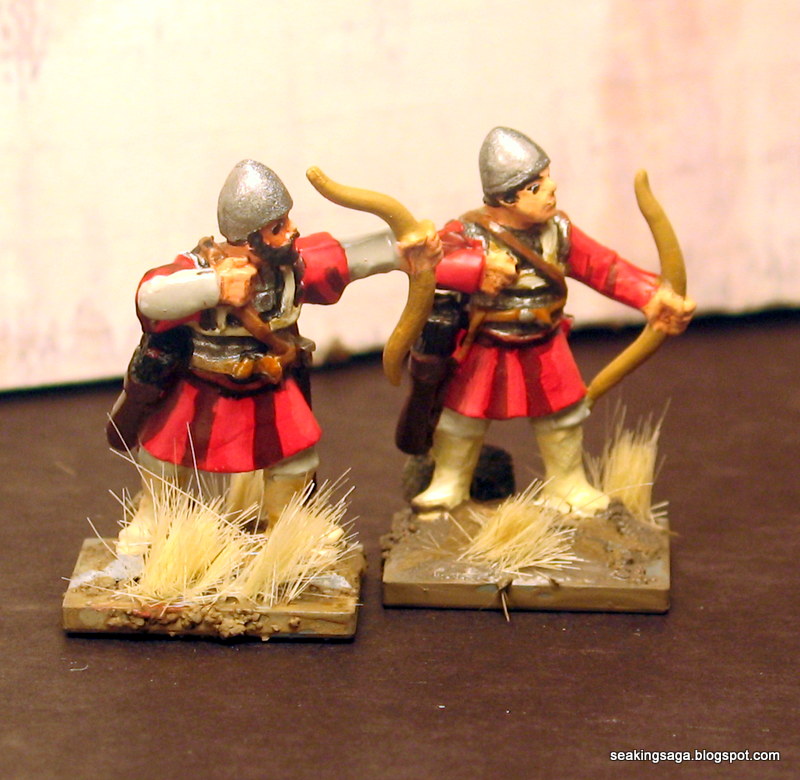
Byzantine Archers
My natural progression from Vikings to Byzantines continues, this time with some Crusader Byzantine Archers.
I have never been less than impressed with the quality of Crusader's miniatures, but the detailing on these may be best suited to a more advanced painter than myself. Scale armor along with multiple overlapping straps and belts is not forgiving to a novice painter. I plan to get better results with some of the unarmored bowmen and spear men soon.
As a rare Medieval example of a standing professional army, the Byzantine forces maintained manuals on training, strategy and equipment. Like the Roman army they progressed from, the Byzantines divided their soldiers into units ranging in size of 8 up to 9000. And while the Byzantine army stressed uniformity in equipment, my use of red tunics and pale leather boots is more of a concession to more modern expectations and depictions. My units of psiloi will show less homogeneity.
Dawson, Timothy. Byzantine Infantryman: Eastern Roman Empire c. 900-1204. Illustrated by Angus McBride. Osprey Publishing, 2007.
Thursday, May 24, 2012
Varangians
As far back as the Republic era, the Roman army made extensive use of mercenary forces. Reliance on foreign fighters waxed and waned over the centuries, but in the Eastern Roman Empire foreign mercenaries were an integral part of the Byzantine geopolitical game. Enemies were turned into allies, and potential invaders were turned against each other as part of the Byzantine strategy to survive in its declining years.
The Varangians were Rus or Scandinavian mercenaries recruited first under Emperor Michael III (r. 842-867), and becoming an elite guard by the time of Emperor Basil II (r. 976-1025). They served as bodyguards for the emperor and fought in Byzantine campaigns in Syria, Sicily and Armenia.
The following figures are all from Crusader Miniatures' Dark Ages line. The eight in robes and bearing axes are from a Palace Guard pack and the spearman is from the Emperor's retinue pack.
For historical fiction, I really enjoy Poul Anderson's Last Viking series about Harald Hardrada, of which a good chunk is set during his exploits as a leader of the Varangian guard. Sadly, the trilogy is out of print, nor is it available in any ereader format.
One of my favorite authors of historical fiction is the previously suggested Stephen Lawhead. With Varangians in mind, his Byzantium is very good. In some respects, it is a stereotypical epic travelogue. A young Irish monk is captured by Vikings and through luck and natural talent, Aidan moves from slave to noble, standing beside kings, emperors and emirs. Much less traditional, and very representative of Lawhead's other historical fiction, is the internal journey of Aidan. His faith as a young monk is studied and routinized, easily maintained in the controlled environment of a monastery. But in the outside world, God's seeming obliviousness to man's cruelty and cravenness shakes his faith, even as he kindles a spark among his pagan companions. At his worst, Lawhead struggles to make Aidan's most mundane activities like eating hot bread feel poetic, but at its best, Byzantium delivers a story that is both panoramic and personal.
The Varangians were Rus or Scandinavian mercenaries recruited first under Emperor Michael III (r. 842-867), and becoming an elite guard by the time of Emperor Basil II (r. 976-1025). They served as bodyguards for the emperor and fought in Byzantine campaigns in Syria, Sicily and Armenia.
The following figures are all from Crusader Miniatures' Dark Ages line. The eight in robes and bearing axes are from a Palace Guard pack and the spearman is from the Emperor's retinue pack.
Reading Recommendations
For historical information, Osprey recently released a Men-at-Arms book on the Varangians. The writing and documentation is solid. The illustrations are detailed and very useful for the miniature painter, despite some stiffness in posing and action.
D'Amato, Raffaele. The Varangian Guard 988-1453. Illustrated by Giuseppe Rava. Osprey Publishing, 2010.
Lawhead, Stephen. Byzantium. Harper Voyager, 1997.
Tuesday, May 15, 2012
More SAGA factions and armies
My circle of Saga players is fairly small at this point, but I do know some people who have a number of Dark Ages Spanish and Irish figures, and might want to bring those into a game. Converting other European armies from the tenth and eleventh centuries can be done if one accepts that there is some limited historical/cultural connection behind a faction's battle board abilities. And if so, those abilities can be transferred to another similar faction. For example, one can easily see that militarily and socially, Normans and Franks are more similar than different.
The table shown above brings in most of the major European armies from the late Dark Ages - at least those that someone might plausibly field armies from currently available miniatures.
Intentionally left off of the list are the Papal states and Italian city states (mostly mercenaries and levy), along with most of the emerging eastern European kingdoms (still researching).
European Faction Conversion Chart
The table shown above brings in most of the major European armies from the late Dark Ages - at least those that someone might plausibly field armies from currently available miniatures.
Intentionally left off of the list are the Papal states and Italian city states (mostly mercenaries and levy), along with most of the emerging eastern European kingdoms (still researching).
European Faction Conversion Chart
Thursday, May 10, 2012
Welsh Archers
I finished a unit of Welsh archers by Gripping Beast recently and I had a blast painting them. The poses are well articulated, the cloaks and robes have the right amount of drape and fold and the faces are expressive. The only drawback is their size. For a "heroic 28mm," their eyes are a standard 28mm, but they are fairly bulky. Posed next to Gripping Beast's plastic Vikings, a Welsh peasant looks like they could overpower the Norse warrior. But on a game table, from four feet away, it matters little.
I especially like the figures with the cloak. Adding a pattern to the fabric was something I debated, but for poor skirmishers, plain red cloth was enough of a luxury.
pictured above, left to right: GB Welsh Archer, GB Viking (plastic) and crouching GB Welsh. Note that the crouching Welsh archer is shoulder high to the standing Viking
Reading Recommendations
For a non-fiction history of the Wales in the Dark Ages, I recommend The Welsh Kings: Warriors, Warlords and Princes by Kari Maund. Spanning the late Roman era through the late thirteenth century, Maund focuses on political and dynastic change in Medieval Wales. It is solid political history, so anyone looking for a broader look at Welsh culture might want to look for a social history of the period. Similarly, Maund gives an accurate and detailed account of what we know and do not know about Welsh battles with each other and against others, but it contains few descriptions of Welsh weaponry, armor or tactics. Nonetheless, The Welsh Kings is well titled. It is a story of kings, and I came away from its 240 pages enlightened about the small fractious kingdoms of western Britain.
The best historical fiction I read set in Wales remains the previously suggested Hood trilogy by Stephen Lawhead. It was very surprising to find an author capable of exploring the Robin Hood mythos in a fresh and moving manner, but this series succeeds. Deserving of repeated readings.
Tuesday, May 8, 2012
Byzantine Faction Information
I haven't managed to play-test the Byzantine faction against many different factions and players to get a full idea of their strengths and weaknesses, but here is a corrected and modified version of the board. I will probably stick with this version because I think it plays well enough and Alex Buchel from Studio Tomahawk said that Byzantines would be an official faction at some point. You can listen to a very good interview with him on the Meeples and Miniatures podcast.
Subscribe to:
Posts (Atom)


.jpg)