Pages

Saturday, April 21, 2012

The Byzantines are coming!


My immediate miniature and wargaming projects are to finish some Viking warlord stands this weekend.  After that, I plan to transition from a few units of Varangians into a small Byzantine army and a scratch built fortress.  Fielding strong cavalry and missile troops, the Byzantines fought Viking raiders from the Black Sea, and more significantly, Normans in Italy and Greece.  They should eventually become an official SAGA faction, but until that happens, I will work on one of my own.

Most of the abilities are adapted from other units, where I saw some sort of historical or functional analogue.  I am not sure about balancing, and will try to play test it in a few days.  The main concept I tried to convey was of a better trained warband capable of hitting hard and fast early in a match, but more challenged in a sustained fight against a very determined or lucky foe.

Legendary warlords will probably be Basil II and Alexios Komnenos and the Varangians would be an obvious special unit.

Suggestions for revisions are welcome.  I will put a revised version up in May after some testing.

PDF Download


Saturday, April 14, 2012

Raiding a Saxon Church

     Here are some photos from a recent match up of Vikings against Saxons.  I took the Saxons and a friend of mine whose gotten the Saga bug took the Saxons.  The scenario was a raid, Vikings wanted the gold candlesticks and silver plates in a Saxon Church.  Here the two sides have spotted each other across the field.  Some taunting is probably going on.


The Saxons advance.


Here a unit of Berserkers has just decimated some Saxon Huscarls.  Sixteen attack dice can do that.  


The Viking and Saxon warlords face off with their warriors.


The Saxons eventually won the day.  After losing outside, the Saxon warlord made it inside the church and through divine providence, and good dice rolls, proved impossible to dislodge.  After losing half their men, my Vikings figured the small church wasn't worth their effort.  The fact that it was 11:30 PM also didn't help my resolve very much either.  

Figures are mostly plastic Wargames Factory and Gripping Beast.  The church was built from Hirst Arts blocks.  

Tuesday, April 10, 2012

Norse Women and Gunnar's Daughter

  Painting civillians is fun, but their usefulness in gaming is limited.  I intend to build and photograph some diorama scenes but that keeps getting delayed behind a pile of unpainted metal and plastic.  Anyway, here's two of Gripping Beast's female civillians sculpted and painted in Norse style clothing, probably as wives of well-off farmers.


Mega Minatures on Ebay sells a line of fantasy townsfolk.  Here's two that are being drafted into service as female thralls on a Norse farm.


From Gripping Beast, a higher born Norse woman, perhaps the wife of a jarl:


And here she is with a servant tending to her child:


     Finding a story about women in the Viking age is difficult. To be sure, there are plenty of Viking romance novels to be found, but there is little in that market that seems to have much substance.  A rarity is Gunnar's Daughter, the first published work (1909) by the future nobel prize winner Sigrid Undset, who was then only 26 years old.


Gunnar's Daughter is a fictional companion piece to the Icelandic sagas. Those sagas in particular, show how minor insults and altercations could spin out of control and turn into bloody feuds.  The lives of farmers, important landowners and their servants are the focus rather than the kings and lords of the Norwegian sagas.  Written in a faux saga style, a enough common affectation now, but probably pioneering for its time, Undset's novel is a hauntingly simple story.  Set in early eleventh century Norway, the daughter of a well-off landowner is raped by a suitor, forever changing both of their lives.  A single violent act perpetuates further violence, culminating almost twenty years later.  

     Like the sagas it emulates, the prose is stark; the physical environment is not ponderously described, and the action and conflict progresses quickly. While it is stylistically similar to the sagas, the thematic differences outnumber the similarities.  Women feature prominently in a number of the Icelandic sagas, but the impact of violence against them is rarely a central concern as it is in Gunnar's Daughter.  Complex and  riveting, Undset illustrates the high cost of love, honor, revenge and faith.

Gripping Beast miniatures purchased from Architects of War.

Gunnar's Daughter at Amazon.com  

Tuesday, March 13, 2012

Icelanders

     Viking is an overused term, but figure collectors and wargamers love it anyways.  The people of Njal's Saga were mostly landowners and farmers concerned with earning a living from their land.  Young men, such as Njal's sons Grim and Helgi, spent a few seasons as crew on a boat, presumably raiding.  However, most of the Icelanders were settlers seeking cheap land far from the increasingly centralized and autocratic rulers of Norway and Denmark in the tenth and eleventh centuries.

Njal was a prominent landowner, lawyer and judge who over the course of fifty years gets entangled in a web of vengeance and violence that proved inescapable.  His oldest son, Skarphedin, was a renowned fighter, and supposedly capable of jumping 18 feet across a river with his battleaxe.  These next two figures are Gripping Beast's character figures of Njal and Skarphedin. 


Njal's Saga is set exactly at the time in which Icelanders voted to convert to Christianity from paganism.  This was accomplished somewhat peacefully, though a few killings did occur in both directions.  Wizards, seers and berserkers make their appearances in Njal's Saga.   


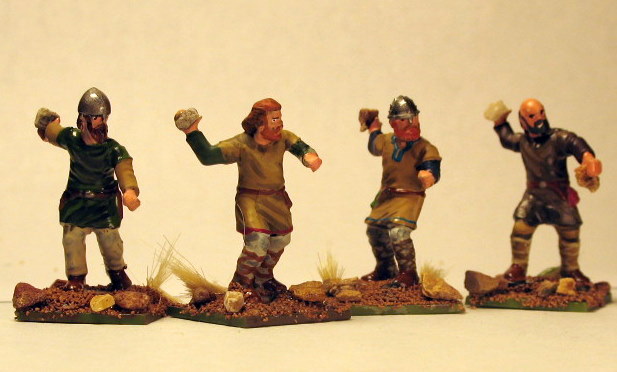
One weapon often described in the Sagas, but rarely depicted on miniatures, is the rock.  During sea-borne battles, rocks are frequently mentioned, presumably obtained from the bottom of the ship where some were probably stored as ballast.  Among the Icelanders, swords and armor were expensive and less frequent so rocks were a ready made missile weapon.  These are Wargames Factory unarmored Bondi converted to rock throwers with a few bits from my backyard. 


Monday, March 12, 2012

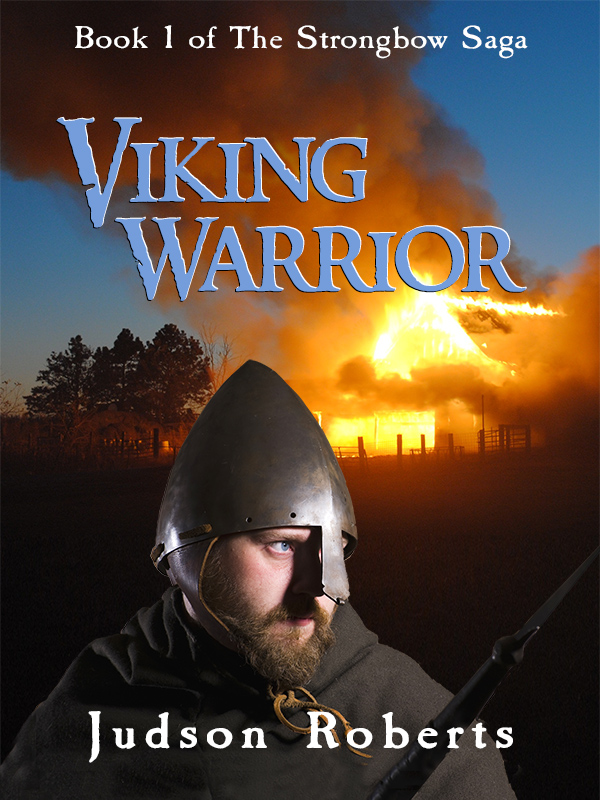
Viking Warrior, The Strongbow Saga Volume 1


     Judson Roberts' first volume in the Strongbow saga is an appropriate follow-up to my photos of thrall archers.  The Norse, like most Medieval societies, were heavily stratified, but not entirely inflexible.  Slavery endured longer in the lands of the north, having given way to serfdom much centuries earlier in the Christian kingdoms of Western Europe.  Furthermore, the Vikings developed a thriving slave trade.  Slavery was not intensive as in Sparta or the Antebellum American South, but slaves were a tradeable commodity.  Viking raids took Irish, Saxon and Frankish slaves to work farmsteads in Iceland, Norway and Denmark and on to eastern markets in Baghdad and Constantinople.  The Viking sagas give a detailed look at the workings of Norse society, including the role of slaves.  However, with few exceptions, slaves in the sagas are depicted as dumb, cowardly and untrustworthy.  Such would be the opinion of the warrior elite whose perspective dominates the sagas. After all, with such low qualities thought the masters, the slaves then deserve their lot in life.
    Viking Warrior is the story of Halfdan, the thrall son of a slave and her Viking master.  A teenager by our standards, but a man in what was harsher times. Halfdan's rise to freedom is both plausible and tragic, and  Roberts' deserves credit for depicting numerous details of the Norse underclass' daily life. Of course, one of the requirements (cliches) of the hero's journey tale is that the hero must be of low origins until his potential greatness is recognized by someone with power to elevate the protagonist's status.  So, Halfdan does not long remain a slave, but retains the worldview of one who had been rejected by elite society.
      Roberts keeps the pace brisk writing with a modern voice rather than the faux-saga style employed by many of the modern authors of Viking fiction.  and soon introduces the villain that will bring tragedy to hisnewly fortunate life.  The villain is brutal and merciless, but ultimately colorless.  For a four book series, new and better written antagonists is a must for one to keep coming back.
     The Strongbow Saga has potential and I will pickup at least one more volume. The nuanced point of view and interesting origin of the hero overcomes the plot's reliance on heroic cliches.

Sunday, March 4, 2012

A Month of Vikings

After a month without posting, March should bring in regular updates featuring a variety of Vikings and Viking related literature.  First, the often maligned Wargames Factory's Dark Ages offerings.  The Viking Bondi differ from the Anglo-Saxon unarmored set in only the head and accessory sprue.  Otherwise, both sets offer the same unarmored/lightly armored bodies in a standing or awkwardly walking pose.  To its main credit, this is the only plastic set currently available that one can use to fill out their ranks of Viking thralls/archers.  It can be difficult to get natural poses from the figures, but with a little shaving of the arms and a willingness to create some lefty archers, some good results can be achieved.


These painted fairly well, at least by my middling standards.  The Norse preference for axes and sword permeates popular history and media, but the bow was a prized weapon by even the best warriors.  In The Icelandic Njal's Saga, the ever feuding Gunnar, armed with a bow and spear, fights off thirteen enemies, slaying many before they even approach him.


My biggest gripe with this line of figures are the heads.  It can take a lot of work to get them to sit naturally.   Here's a group shot of a point's worth of Saga thralls.  A few wear chain, but maybe they were lucky scavengers.  


Njal's Saga may be my favorite Icelandic saga.  Set at the turn of the eleventh century, it is a violent and darkly humorous account of the blood feuds among the self-governing Icelandic settlers.  There are no epic battles or king-making moments of glory in this account.  It does have more premeditated murder and domestic violence than a hard-boiled mystery novel.

Njal's Saga at Amazon.


Sunday, January 29, 2012

Shield Maidens

       Shield Maidens, or female Vikings, are most definitely a non-historical creation, borne out of a combination of fantasy literature, mythological archetypes and modern feminism.   Nonetheless, these Foundry Shield Maidens can make a neat addition to a dark ages skirmish.


One of the Vinland sagas relates a story in which attacking Skraelings (Native Americans) were scared away by a screaming and topless Norse woman.  I haven't found a model to represent that yet...


While any scenario involving female warriors on a Viking raid may be considered fantastic, it is not out of the realm of possibility to include women as defensive fighters at a homestead.  Stories from the Viking age testify to the bloody feuds that drew whole families into combat.  


Further Reading:  My second favorite story arc from Brian Woods' often brilliant series Northlanders is titled, appropriately, "Shield Maidens." It creates a plausible scenario that pits three Norse women against a party of vengeance minded Saxons.  It is included in the collected graphic novel, Northlanders Vol.3: Blood in the Snow.