Pages

Friday, June 20, 2014

The Knights of Islamic Spain

Gripping Beast's Plastic Arabs are good for the bulk of your force, whether you are skirmishing or doing mass combat, but you are going to need to supplement them with some heavy infantry.  And for that, metal figures are currently the only option. My first era of interest in wargaming was El Cid Spain and over the years I have picked up a decent variety of ranges from a few companies.

Gripping Beast produces several lines of Arabic or Islamic themed miniatures.  Below are some Andalusian infantry, the Arab or Arab-Spanish warriors of early Medieval Spain, which I painted recently.


The knights of Cordovan Spain were poets as well as warriors. Christian warriors from Europe including the mighty El Cid often took up service among the rival emirates in southern Spain. There, the Christians were exposed to ballads, poems and refined court manners.  After returning to their own lands, the influence of Muslim Spain can be seen in the culture of troubadour songs, chivalry, and courtly love that developed in feudal Europe during the high Middle Ages.

Andalusian warriors were also showy in their dress and armor. The poem below, from eleventh century Spain, makes note of the brilliant styles:

The Two Moorish Knights

Upon two mares both strong and fleet,
White as the cygnet's snowy wing,
Beneath Granada's arching gate
Passed Tarfe and Belchite's King.


Like beauty marks the dames they serve;
Like colors at their spear-heads wave;
While Tarfe kneels at Celia's feet,
The King is Dorelice's slave.

With belts of green and azure blue
The gallant knights are girded fair;
Their cloaks with golden orange glow,
And verdant are the vests they wear.

And gold and silver, side by side,
Are glittering on their garment's hem;
And, mingled with the metals, shine
The lights of many a costly gem.

Artizan Designs also produces a line listed as "Moors," an overly general term, for their offerings include Andalusians, Berbers and Sudanese Africans.

This pack of eight included two poses, one of whom wears chainmail under his robes and the other quilted armor.  I painted these a couple of years ago (or more) but did some retouching, especially on the shields.


Overall, I think the Artizan wins the shoot-out.  The Gripping Beast figures have less distinct facial features and some of the chain mail detailing is a little muddy.  And while the splayed arm pose on the Artizan figure is awkward, it is dynamic on the game table.

Thursday, June 12, 2014

In the City - A Byzantine Urban Skirmish


Very little figure painting was accomplished this past week. Non-hobby related duties took precedence, but I managed to put together a few movement trays.  I did also play a new skirmish game which I think shows some uses for paper terrain for the historical wargamer.


The rule set was a Song of Blades and Heroes variation based on urban violence in the Ancient era - think HBO's Rome TV series.  It did not take much effort to convert some of the character types to medieval Byzantines.

Different characters have different special abilities, and what appealed to us was game mechanics involving the civilian characters.  If violence occurs near civilians, they may either run or join in.  Also, characters with certain abilities can try to recruit civilians to their side.  Buildings can be entered and exited, and rooftops can be an additional combat surface.

As with all of the SBH rules, it is fast moving and easy to pick up.
 In this scenario, an emperor's relative has stopped at a small Mediterranean or Black Sea port and is heading from the market back to the jetty where a small boat can take him to a ship.  Unfortunately, somebody high up wants him dead and the local governor, the Praetor, and some spearmen are to eliminate him.  The town guard (archers on the wall) are not in on the plot, but might be recruited to either side.


The emperor's brother and his Varangian bodyguards at the market:


The two side's assassins pursue each other through an alleyway.  


Shortcut through the alley now that the enemy assassin has been taken care of: 


And, like most skirmish games, strategy and tactics devolves into a melee free-for-all in the end: 


The terrain is mostly from Fat Dragon.  Many of Fat Dragon's PDFs have different layer options so tile roofs and shingles give the buildings the medieval Mediterranean look.  It's not exact by any means, but even with the cost of inkjet cartridges, it is less expensive than resin buildings and streets. On the downside, construction is time consuming and getting an exact fit can be fussy as some of my pics show.

Ganesha Games has Song of Shadows and Dust  as does RPG Now, which is where I bought the Fat Dragon terrain.

Friday, June 6, 2014

Arab Infantry in Unit Colors

One of the main reasons, I focus on the Dark Ages, rather than earlier (Roman) or later (Gunpowder) eras is that I don't usually like painting units.  I started out in miniatures in my teen years as a fantasy RPG player, so even in wargaming, I like the individuality of the figure.

However...maybe I am of a different mind now.  While working on my Gripping Beast Arabs, I also decided to hit the lead mountain and paint this unit of Arab infantry from Essex.  Colors and heraldry may have entered Europe through exposure to Muslim armies in Spain or the Near East, so uniformity of colors may be appropriate in this instance.

Essex is one of the older players in the historical miniature market and the figures are a bit dated.  The posing is stiff, the hands are poorly formed and they are a bit "flat" which was a necessity in older casting tech.  On the positive side, fabric folds and belt details are finely done and hold up alongside recent lines.


I like the look of a 15 man unit (two are not pictured) lined up in identical colors.  A unit of identically painted Holy Order Crusaders might match against them nicely.  The movement tray is from Litko and the printed flag was found at the DBA Fanaticus site: Flags and Banners for DBA

Bonus pic below is another easy conversion of a GB Arab head on a Wargames Factory Numidian body for a light skirmisher.


Saturday, May 31, 2014

A Scottish Interlude

With a couple of SAGA games planned for this week, I needed to finish out my four points of Scots into a proper six point warband. All that was necessary was a warlord and a unit of Mounted Thanes that had been in my unpainted box for far too long. And after finishing about 20 plastic Arabs, I needed a little something different to paint.

Below, a Warlord stand and Standard Bearer.  Minis from Crusader, banner from Little Big Man.


My only complaint about Crusader Miniatures is that their cavalry is sold in threes, making a blister pack one short for a SAGA unit.  I'll probably throw in a Strathclyde Welsh to fill the unit out.  Below, the finished warband - three points of Thanes (one mounted), two Soer-chele and one Doer-chele.


Finally, if anyone is also interested in fantasy miniatures, I will be posting pictures of my efforts in that genre on a new blog Fantastically Small.  My two oldest children (ages five and nine) enjoy pushing fantasy figures around a table to the Song of Blades and Heroes rules, and I have enjoyed putting together and painting random figures that strike our interest. Thanks! 

Thursday, May 29, 2014

Gripping Beast Plastic Arabs and Old Glory Cavalry

This past week I have continued to assemble and paint my Gripping Beast Arabs like a number of SAGA players waiting for the Crescent and the Cross release.  I also picked up a few Old Glory Arab cavalry from a dealer at a show selling them in packs of two (rather than 10).  It was probably less economical but more convenient than buying OG's large packs.

Shown first are some of the plastic spearmen.  Three of the figures below have shield transfers from Little Big Man and it's probably hard not to guess which. While I have no complaints about the transfers, it would cost over half the box price to buy enough transfers for 32 spearmen, so hopefully the hand painted shields do not seem overly wanting next to the transfers.


Below, a very easy conversion of an Arab turbaned head fixed on a GB Dark Age Warrior body. This would be good to mix into Andalusian or steppe armies.


Archers, which are probably my favorite part of the box, and far more adaptable than one would expect.  


Using the veiled head I created a unit of Black Guard, elite troops used by the Almoravids in their push into Spain in the late eleventh century.  In hindsight, I wish I added more variation to their paint scheme such as a lighter colored veil after my son looked at my finished product and said, "Daddy, I like your ninjas!"  Note: the hide shield are not a part of the Arab box set. I made most of them by sculpting a prototype and casting duplicates in Instant Mold.


Here is a four man unit of cavalry by Old Glory.  I like the sculpting, and the horses seem to be an improvement over the last Old Glory figures I purchased. There was a slight mismatch on the fit between horse and rider on a couple of the figures, but it was easily filled with a dab of green stuff.  


The two camels are Old Glory as well. I know from the Studio Tomahawk blog at least one faction will use camels, but these were more of an impulse buy than anything.  Never painted camels before, and it was quite fun.  I'll probably get some Black Tree Design camels next.  


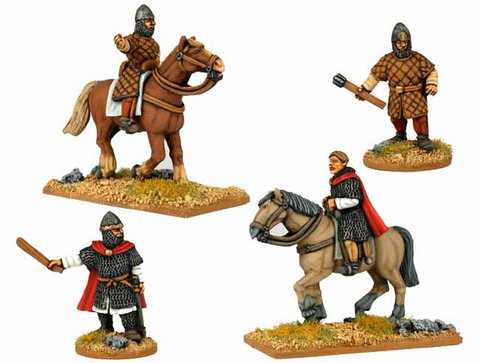
Finally, a couple of command figures.  While not specifically identified, the figure on the left with the smaller horse and long braided hair would probably be a Seljuk and the figure on the right looks more appropriate for the mid to late twelfth century, with his Saladin like figuring.  


Reading Recommendation:

The Crusades Through Arab Eyes by Amin Maalouf.  Maalouf integrates numerous Arab chronicles into an entertaining narrative history explaining the reaction of the Turks and Arabs to the Crusaders. He writes with a slightly affected period voice - such as calling the Crusaders the Franj - as they would have been referred to at the time.  The epilogue is particularly useful for clearing away numerous misconceptions by both the West and Arabs over the causes and lasting effects of the Crusades.

Saturday, May 24, 2014

Thanks, Red Dog!

Red Dog at Dogs of War has been blogging for two months now about two of my favorite games, Saga and Ronin.  He was kind enough to nominate me for a Liebster Award.  I'll need to nominate in turn some of my favorite blogs, although I am a bit behind on my blog reading with the end of the school year rush.  Thanks again, Red Dog.


1. Why did you start blogging? I am not really sure now, but as someone living outside of a metropolitan area, my chances to game are few and far between.  I think I saw blogging as a way to share my ideas and efforts with others, as I had little chance to do that locally.

2. If you could change anything about the wargaming hobby, what would it be?  Not really my place to decide what is best for the hobby, but I would probably wish more success for struggling designers and manufacturers.  Technology is great and information and design technologies are no longer exclusively held. It has never been easier to start a small manufacturing business, but the margins have been squeezed so thin to be almost non-existent.

3. What is best in life? family, faith, rewarding work and time well spent gaming.  A more worldly answer would be Vallejo paints, stout beer and Fender Telecasters.

4. Do you want to live forever? No, but I might like an extended deadline.

5. Fame or fortune? Fortune.

6. What miniatures are you most proud of painting? Usually whatever I painted last.  Like my nominator Red Dog, probably some samurai that I painted for Ronin.  I've put together a Sohei buntai for Ronin, now I am doing a Samurai faction.  Here are some Assault Group samurai with no dachi swords.


I also enjoy painting fantasy miniatures (see next question) and here's some Mithril Miniatures I am working on.  I've had the Gandalf since the early 90s.  I am slowly putting together the Fellowship and a few others.  Mithril's are very nice, but very expensive so it's slow going. Hopefully when finished, it will be the unit I am most proud of.  


7. How do you deal with burnout? Painting is usually my stress reliever, but like any hobby it can be  source of anxiety if you take on too much.  I usually like to work in a fantasy figure to break the monotony.  I buy the Reaper Bones and use it to introduce my children to painting and gaming.

8. Why is a raven like a writing desk?   Because that's the sound of one hand clapping.

9. Star Wars or Star Trek?  My wife was rewatching all the Star Trek movies this past week (she is one of us!) on Amazon Prime and I have to say they aren't holding up with sole exception of Wrath of Khan.  I love the Kirk/Spock and McCoy dynamic but the inconsistent quality of the scripts, effects and universe.  The Abrams reboots leave me cold as well.  I'll take Star Wars Episodes I-III over lens flare and a spoiled brat Kirk any day...which doesn't give me much confidence about Episode VII.

10. If you could only buy one miniature company from now on, which one would it be?  Crusader Miniatures, no doubt.  I would love to have over a hundreds of the Byzantines and Normans each and play the Battle of Dyrrhachium with Hail Caesar rules.

11. What is your favorite takeaway?   Probably a gyro with cucumber sauce from a local diner, Domino's Pizza a close second.


Wednesday, May 21, 2014

1066 Part 5: Odo of Bayeux

Companion to William the Conqueror, Bishop of Bayeux, Earl of Kent - Odo certainly collected many titles in his sixty-plus years but he his best remembered for the famous Tapestry housed at his bishopric, which he probably commissioned himself.

Odo was born around 1030, several years after his half brother, William. Their mother Herleva was not, as many claimed an believe, the daughter of a common tanner, but definitely not from high nobility.  After a youthful and unconsecrated relationship with Duke Robert I of Normandy resulted in the birth of William c. 1027, Herleva was married off to Herluin, Vicomte of Conteville. She bore him two sons, Odo and Robert, both of whom later played significant roles in the conquest of England. The date of Odo's birth is unknown, but when he was made bishop of Bayeux in 1049, his age was between 14 and 19. Very young to be sure, but not too surprising for one so well connected.

Being a bishop did little to suppress Odo's worldliness and greed, and in fact probably gave license to his corruption.  His wealth did allow him to patronize a variety of artistic and architectural endeavors. In 1066 William entrusted Odo with the task of raising ships and supplies.  He directed troops in the Battle of Hastings, though he probably did not personally engage in melee. After the conquest, Odo was given numerous estates in England and held the title of Earl of Kent.  Afterwards, William spent most of his time in Normandy, leaving Odo as his regent in England.  


On the Bayeux Tapestry, Odo is depicted wielding a club or mace.  Victorian historians attributed this to a supposed ban on religious leaders carrying swords and shedding blood in battle.  While early Medieval church reforms discouraged bishops from engaging in battle, no such proscription on swords exist.  In truth, Odo's club was a symbol of authority not piety.  Undoubtedly, this image and associated stories served as the inspiration for the requirement in Dungeons and Dragons that the Cleric class could only carry blunt weapons - because braining your enemy to death is much more compassionate that stabbing them!

Odo spent his later years out of favor with his brother. This was largely Odo's fault, for he was imprisoned for a variety of corruptions and plots. On William's deathbed, the king ordered the release of all his prisoners with the single exception of Odo. William's advisers, specifically their brother Robert, pressed for Odo's freedom and succeeded.  even attended Wiliiams funeral.  Later, Odo was forced to leave England for plots and remained an advisor to William's son Robert, who inherited Normandy, but not England. He joined his nephew on the First Crusade, but died en route in Italy in 1097.

Modeling and Playing Odo

Like William the Conqueror, the top Dark Age manufacturers Crusader and Gripping Beast sell figures for Odo. Gripping Beast's mounted Odo is very close to the depiction on the Tapestry with its triangular patterned quilted armor.


Below, Odo from the other side, leading a pair of Conquest Games plastic Normans. 


For an Odo on foot, Crusader makes a figure in padded armor.  I used one of Gripping Beast's Angry Monks, with chainmail and a sword, indicating a higher ranked official than just a lowly monk.  


From Crusader Miniature's website, William and Odo


For SAGA, Odo can only lead a Norman warband and may not employ any swords for hire.

Hero of the Viking Age—As a Norman Lord, Odo generates 3 SAGA dice per turn instead of the usual 2 for most Warlords.

Bishop— As a lord bishop, Odo benefit's from the Lord's protection. During melee, Odo can discard Attack Dice in exchange for an equal number of Defense Dice, rather than half as is normal.

Greedy —On the other hand, Odo was quite rapacious, seeking every advantage possible. At the start of each turn, Odo can roll seven SAGA dice instead of six, assuming his warband can generate that many dice. 

Two of his abilities have been used before for other SAGA heroes, and the Bishop ability was created to emphasize Odo's "lead from the rear" approach.  It makes him hard to kill, but less offensive.