Pages

Tuesday, March 11, 2014

1066 Part 2: Harold Godwinson

The death of the childless Edward the Confessor in January of 1066 presented England with a crisis of succession.  Lacking any heir, the three rulers - Harald of Norway, the newly enthroned Harold of England and Duke William of Normandy - pursued their claims on the battlefield, with William emerging final victor... at least according to the oft told history.  In actuality, there was a perfectly legitimate blood heir to the throne, Edward's young grand-nephew Edgar. The reason why Edward did not become king and Harold did is largely a matter of his young age and the power of the Godwin family.

Harold's father Godwin was Sussex thegn of some, but not great importance in the time Ethelred the Unready, Godwin readily adapted to the conquest of the Dane King Cnut in 1016. By the time of Cnut's death in 1035, Godwin had become the powerful Earl of Wessex.  After brief reigns by two of Cnut's sons, the earls of England invited Ethelred's son Edward back from exile in Normandy to reign as king in 1042.  Edward chafed under Godwin's attempts to control him, and a dispute in 1051 led to the entire family's banishment from the kingdom.

Harold, the second son of Godwin was born in 1022, and already and earl in his own right at the time of his family's banishment in 1051. He went to Ireland, where he had friends and allies, which the Godwin's used to force their restoration the following year.

Following his father's death in 1053, Harold took on his role as the wielder of real power in England. As leader of the king's army, in 1062 and 1063 he decisively dealt with Welsh raiders by boldly marching into the Welsh lands.  Such was the pressure he placed on the Welsh, that Gruffud's own allies killed him and sent his head to Harold.  Less understood is the trip that he made to Normandy in either 1064 or 1065 (the sources are in dispute). Either by intention or accident a boat bearing Harold landed in Normandy and Harold became the unwilling guest of the Duke for a few months.  Harold's Normandy visit ended with a much debated incident in which the English earl swore fealty to William, supposedly upon some holy relics.

Immediately following Edward's death in 1065, the English witan - a council of Earls, met and conferred the crown on Harold.  It was done rather quickly, so much so that he was coronated even before Edward's burial.  Victorian era historians imagined the witan as a precursor to Parliament, with Anglo-Saxon England a proto-Constitutional monarchy, only to be corrupted by the autocratic despotism of the Normans. In reality, the exact function and role of the witan is rather confusing, and while rarely used it was mainly a tool of the richest and most powerful earls, in this case Harold.

However, Harold was probably the most capable ruler of all the claimants to the English throne.  He was literate and had progressive tendencies.  He put good governance ahead of family when the northern part of the realm rebelled against his brother Tostig's misrule.  He was well traveled and had diplomatic links as far as Rome and Russia.  As a commander, he defeated a variety of opponents including Norse, Welsh, and Bretons, sometimes in their own territory.  But a string of victories cannot make up for one staggering loss.  After holding together a larger, but tired and less disciplined army, against the Normans on the 12th of September 1066, Harold was felled in battle and his army routed.

Modelling Harold Godwinson

From the Bayeux Tapestry to later artistic representations, Harold is almost always represented as a physically impressive man, with brown hair and a mustache.  Gripping Beast and Crusader Miniatures both produce figures for Harold that adhere to this tradition. The two shots below are Crusader's Harold, based along with an axe bearing housecarl from Conquest Games.


Gripping Beast sells a pack of Harold with his brothers Gyrth and Leofwine, all three of whom were killed at Hastings.  This is the promo pic, which looks like a nice purchase.


Harold in Non-Fiction and Historical Fiction
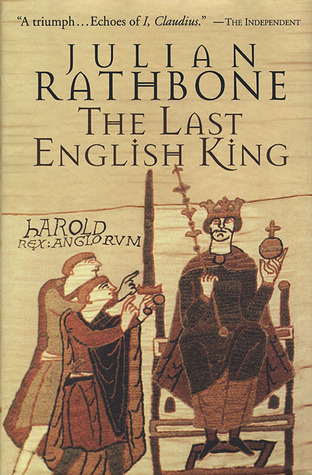
The previously recommended Last English King by Julian Rathbone is excellent, especially if one is looking for something a little more post-modern than straightforward action-adventure historical fiction. Set in 1070, it concerns a Frisian monk named Quint and his wanderings across Asia Minor with a crippled survivor of Hastings named Walt.  Quint slowly pries the story of Harold from Walt, and my favorite exchange between the two is this account of the battle:

     'A fighting man should stand on his own two feet and exchange blows with his adversary until one or other drops.  Besides, good horses are valuable, and can get killed in battle.  I saw three die between William the Bastard's thighs on Senlac Hill.  I could scare afford one horse, let alone three.'
     'But...'
     'If you are going to say they won because they fought from horses, forget it.'
     His face was suddenly suffused with angry blood again and Quint wisely chose not to pursue the subject.

If one wants to get an impression of the high regard that Victorian English held for Harold, a good place to look is G.A. Henty.  A tremendously popular Victorian writer, he is not well known today. That is a shame because Wulf the Saxon is an example of the "boy's own" genre that holds up to this day.  Like the previous book, the main character is a young Saxon, Wulf in this case, who has a fly on the wall perspective on the events leading up to Hastings and the aftermath.  As an added bonus, a free audio version is available at the public domain repository Librivox.

Most of my research on Harold comes from Harold: The Last Anglo-Saxon King by Ian W. Walker. It is a rare modern biography of Harold, and generous to his legacy.  Walker nicely balances the difference between a scholarly work and a popular history.  


Wednesday, March 5, 2014

News from Gripping Beast

Today's Gripping Beast newsletter contained loads of good news for fans of SAGA, some expected and some unexpected.


First, the supplement for SAGA The Crescent and Cross is in the final editing stage and the "hopefully available at Salute."  They promise "loads" of new factions covering the early Crusade in the east and the conflict with the Moors in Spain.  Previous word was six factions will be included.  My prediction for the six factions are:

1) Christian Spaniards
2) Andalusian Caliphate/Taifa Kingdoms
3) Almoravids
4) Early Crusaders
5) Seljuk Turks
6) Fatimid Egyptians

Besides historical reasoning, I am also basing my prediction on Gripping Beast's current line of Crusade era miniatures, which seems to support multiple Arab armies of Turkish, African and Spanish composition.  Another possibility is releasing two Crusader factions, the Franks (those led by Robert of Toulouse, Baldwin and Robert of Normandy) and the Italian Normans (led by Bohemond and Tancred).  I'll further predict that Bohemond, El Cid and Yusuf ibn Tashfin (Ben Yussuf) will be Hero characters.


While the Crescent and Cross has been talked about and promised for over a year now, this other bit of info in the newsletter was a certainly a surprise. Plastic Saracens!  Also slated for a Salute release, this box of 40 plastic warriors can fill out your ranks with archers (16), javilines (16) or spearmen (up to 32).  Excellent, no more of conversions of Conquest Normans.

News and photos from Gripping Beast 

Thursday, February 27, 2014

How I Paint - Irish Warriors

A little background on myself - last summer for my birthday my wife bought me the DNA test from the popular genealogy web site.  It was great fun, and I found out some interesting facts about my ancestry.  About 90% of my DNA matched to three areas of Europe: Northern France, Ireland and Scandanavia.  So apparently, my genetic stock is composed of the Normans and Vikings that invaded and settled in Ireland.  Not the nicest bunch of ancestors, but it might explain my enthusiasm for this particular time and place.

The wargamer and miniature collector in me noticed a problem.  Viking ancestors? Got them. Normans? Loads of them. Irish?  Uh oh, nothing there. I had a few random Crusader Irish from a grab bag purchase, so to fill out a small warband I ordered some extra packs from Age of Glory.  They are a good source of Crusader Miniatures in the U.S., and my order arrived within a week.

I don't rate myself as a top painter by any means, but some of my students interested in gaming and miniatures have asked about how I paint, so here is a summary of the process:


First step is priming.  Testors white primer if I am painting lots of flesh tones and fabric, black if I am painting chainmail and fur.  


Block painted. I would like to say that I always think about selecting a color palette for a unit to create visual cohesion, but I am more intuitive than that.  I try to think of colors and patterns that are historically appropriate yet visually appealing. 


Washing and shading.  I generally apply a sepia wash to whites, yellows and tan colors, and mix a darker shade on colors like reds, greens and blues. 


Highlighting, fabric patterns and eyes


Glued onto circular bases. I then add a mix of white glue and sand or railroad ballast.


Bases with static grass and Army Painter grass clumps.


Tuesday, February 18, 2014

Edward the Confessor

This is the first in a series of posts about the historical figures associated with the Norman invasion.  Historical information, miniature options, wargaming uses and historical fiction will be covered in this five (possibly six) part series.

King Edward the Confessor


While not a warrior or conqueror, Edward the Confessor was certainly a compelling figure in the eleventh century. The unique circumstances of his life and death led to the Norman invasion which is often rated as the most significant event in English history.  He was born c. 1003, the son of King Ethelred (the Unready) and Emma, daughter of Duke Richard of Normandy. After his father's death, Edward and his brother Alfred went to live in Normandy among his mother's relatives.  It was here that he developed an outlook on religious practice and organization that differed from his home country. Edward was finally invited to rule in 1042 after the death of his half brother Harthacanut.  He took the throne beholden to the powerful Godwin, Earl of Wessex, who years before had a role in the murder of Edward's brother, Alfred. Throughout his reign he tried to check the growing power of the earl and his numerous sons, but was apparently forced into a marriage with Godwin's young daughter Edith.  It was a childless marriage, the nature of which is still a source of speculation.  In 1051, conflict with the Godwins over appointments and the treatment of royal guests escalated to such a degree that the Earl and his sons were exiled from the kingdom.  Edward's triumph over the family was brief.  A year later, with Godwin and his men encamped in London and his own army wavering, Edward was forced to restore the family to their lands.  After Godwin's death in 1053, the aging Edward left more and more of the kingdom's administrative duties to Godwin's son Harold, but nonetheless encouraged his earls to strongly deal with threats from Scotland and Wales.

He died in January of 1066, and was buried in the still unfinished Westminster Abbey, a project that he had begun over twenty years earlier. He was eventually canonized, the only English king so honored.


Modeling Edward:

As far as my googling skills could turn up, no manufacturer markets an Edward the Confessor figure in 28mm (or any other scale).  Edward was often described as a tall, fit man with a prominent white beard.  The figure pictured above is an Anglo-Saxon king from Black Tree Designs. His guard is a mix of Gripping Beast metals and Conquest Games Normans with Dane axes. 

Use in SAGA:

Edward is not exactly a character that the average gamer is clamoring to play.  He was not a warrior, and England had little direct threat during his reign with occasional raids from her neighbors.  In fact, with little to fear from overseas invaders, Edward ordered much of his navy scrapped, lowering taxes in the process. However, with the three principal belligerents from 1066 (Harold, Harald and William) already depicted in SAGA, it is natural to find a place for Edward.

One could use generic Anglo-Saxon or Anglo-Dane king as Edward, and give him typical Warlord rules. For a more customizable character, I used two of the Charlemagne traits from The Raven's Shadow, along with a modified two SAGA dice rule. It should be acceptable in terms of game balance and if anything, Edward is nerfed a bit like my previous custom characters.

Elderly: Taking the throne at the advanced (Medieval) age of 40, Edward generates only 3 Attack Dice In combat, rather than the 5 usually granted to Warlords. He may not voluntarily engage the enemy in melee, and is not subject to the Warlord's Pride rule. He may not use the side by side rule.

Blessed: Although Edward only generates two SAGA Dice, his piety and devotion guide and reward him. Therefore, as long as he is on the table, one SAGA Dice can be re-rolled per turn.  This must be done during the Orders Phase.

Household: At the start of the game, one unit of four Housecarls may be designated as his royal guard.  The armour value of these household troops is increased to 6. Its role being that of the king’s bodyguard, if this unit starts the Activation Phase of its controlling player more than M away from Edward, it takes two FATIGUES.


PDF Download of Edward's Character Card

Suggested Reading (Historical Fiction)

The predominant view of Edward has long been that of a saintly and slightly withdrawn king who cared little for earthly matters, aside from hunting.  For a nuanced view of King Edward, check out Alfred Duggan's The Cunning of the Dove.  Decidedly pro-Norman and anti-Godwin, Duggan's pre-1066 England is withering under fractious rule by incompetent and jealous earls. King Edward is genuinely devout and celibate, who, as the book's title implies, subtly tried to insure that his successor will be one who will reform the church and centralize authority.

Edward the Confessor also plays a prominent role in Julian Rathbone's The Last English King.  Here he is not so celibate, in a not-that-there's-anything-wrong-with-that depiction. This Edward is also more petulant and selfish, and lacking the foresight to see the damage that his death will bring to England.  It's also a very thought provoking book about the basis of power and authority, along with some intentionally sly anachronisms. 

Up next will be a look at Edward's brother in law and immediate successor, Harold Godwinson.

Sunday, February 16, 2014

Game Report: A Feast of Crows

This week, I met up with a SAGA gamer through the Studio Tomahawk forum who lives relatively close to me.  For those who live in a game store laden metropolitan area, "close" means someone who shares this rather obscure hobby within an hour's drive.

With three people playing, we went for the Feast of Crows scenario, slightly modifying the starting deployment. I fielded my Scots, my first time playing the faction, while my two opponents went with the Normans and the Welsh.  If one wants to be historical, its an encounter that could take place in Northumbria in the 1070s or 1080s, as the Normans pushed the boundaries of their English conquests.


Above, after the first turn, my Scots move into cover with Normans to the left and Welsh to the right.


The first encounter takes place between the Normans and Welsh, as a group of Sergeants get pelted by Welsh javelins.  


On the other side of the field, Norman knights take a hit from the Scot Levy javelins as they bear down on a unit of Thanes.


The Thanes were wiped out by the Knights, with me losing three of the Scots for two Knights.  Above, I pull up a unit of Soer-Chele to assist the levy. 


The Scot Warlord and Thanes turn back the Welsh Warlord and mounted Teulu without a single loss. 


The Norman player's collection of defeated models, winning with the most victory points. My quick after-analysis says that Norman win was because the player took advantage of their two strengths - they are "shooty" and heavily armored. I like the Normans for the same reason. Despite my second place finish, I feel good about the Scots and plan to use them again, but perhaps with a bow levy instead of a javelin levy.  They are very defensive, which suits my play style very well, but with some nasty abilities such as Hold the Ground and Give Ground, both very devastating if used correctly.  

Thanks to The Battlegrounds in Dalton, Georgia for letting us use their space.  I am sure we looked odd amongst the Yugioh and Magic players, but their stock of board games and RPGs was top notch. Their racks of vintage NES, Sega and Playstation games was temptingly nostalgic, and I plan to pick some up the next time I am in there.  I look forward to more battles with my new friend, and possibly converting some of the curious teens who wandered over to our table into wargamers. 


Monday, January 20, 2014

Varangians and upcoming plans

The Byzantine army continues to grow.  My work this week was a pack of Crusader Miniatures Varangians, a command pack and several plastic conversions.


Turned with the shields shown.  I generally prefer handpainted shields to transfers, even if the are a kittke too clean. A personal painting goal for this year is to work on weathering and damage.  However, it is a little hard psychologically to do a nice job on a shield, and then paint over it and intentionally ruin your work.  


Harold Hardrada, center, with his command retinue.  I do not know why it wasn't obvious to me before, but Harold probably shouldn't be given the appellation Hardrada ("Hard Ruler") during his Byzantine service, because he had yet to rule.  Furthermore, according to most sources, that name does not appear in written records until well after his death at the Battle of Stamford Bridge. 


Several conversions are pictured above.  On the left is a Byzantine artisan or merchant, flanked by two Varangian in their more formal tunics.  The civilian is a Wargames Factory Numidian puttied up and painted according to this reference.  The Varangians are Conquest Games Normans with Gripping Beast Dark Age heads. The bases are from Happy Seppuku stamps.    

I plan a few more civilian conversions for some skirmishes using Byzantines in the recently released Song of Shadows and Dust.  It is a SBH variant for urban combat in the ancient world.  Most of the buildings and streets will be papercraft, which I enjoy using (see the pic above). Maybe next month...after some more 1066 stuff...

Thursday, January 16, 2014

Character Card Updates

Quick notice, on the Downloads page I have added links to newly created PDF character cards for my previous homebrew SAGA heroes.  Included are Alfonso, El Cid, George Maniakes and Gruffud ap Cynan. Expect a few more historical character cards in the near future.  I am currently reading some books on Edward the Confessor and the years leading up to 1066, and some ideas are developing.