Pages

Tuesday, October 15, 2013

The Byzantines are Back in Town

When life happens, blogging doesn't.  Honestly though, a month off from the blog does not mean I abandoned the hobby.  So while I was a bit busier with job and family commitments, I have painted a few units and almost finished a fairly massive terrain piece that I will post later this week. In gaming, I played some SAGA and Song of Blades and Heroes, and ordered the Hail Caesar rule book when I caught it on sale on Amazon for 34% off.

In the meantime, I am trying to build up a couple of my skirmish armies into the sizes necessary for more massive battles, starting with the Byzantines and Normans.

Below, are Crusader Miniatures' Byzantine Kataphractoi with spears and maces.  The troops are nicely posed and detailed, but my one critique is that the armored horses had far more flash on the rear legs than on Crusader's other horses.  Whether I got a bad batch, or if its typical of the bulkier barded horses, I cannot say.


Next, are some shots of armored skutatoi and archers.  The variations on leather and chainmail armor kept the painting process interesting, while still maintaining visual cohesion.  Admittedly, Byzantines are a bit of a challenge, as I am more accustomed to painting generic Dark Age Vikings, Saxons and Normans.  Someone coming at them from a Roman Imperial direction would find it standard practice.


Historical Fiction Recommendation

I am not sure if anyone else in the hobby has this compulsion, but I like to read what I am painting.  While painting the Byzantine Cavalry, I read some fiction and non-fiction set in the Byzantine Empire, mostly some Osprey titles, but also this new discovery:


I found Strategos: Born in the Borderlands and Rise of the Golden Heart by Gordon Doherty through a Goodreads group.  The two released books of a trilogy tell the story of Apion, an orphaned Byzantine raised by a Seljuk farmer in eleventh century Anatolia.  From a childhood in slavery, he rises to a commander in the Byzantine army in the years leading up to the Battle of Manzikert. Doherty writes compelling battle scenes and builds the air of conspiracy and danger that gave the alternate meaning to the word Byzantine.  On equipment and tactics, the novels are well researched, but he makes some assumptions about the organization and activity of Byzantine thematic armies that I have not read elsewhere.  It is nothing disruptive to the plot, but it did pull me out of the narrative occasionally as I wondered if it was history or invention.   He also admittedly invents the shadowy enemy pursued by the main character, but it is based on an earlier Roman imperial practice.  Both books are available on Kindle.

Strategos: Born in the Borderlands


Thursday, September 12, 2013

Kit Bashing Dark Age Skirmishers


SAGA's push to the east, beginning with the Byzantines and Rus in Varjazi & Basilieus has pushed further into Asia with the release of the new Steppe Tribes board in Wargames Illustrated 311.  It is a welcome move, for it is a time period and location in which I have a a great deal of interest and background.

As I have been putting together levies for SAGA and Hail Caesar lately, my expectation is that cheap (low quality) troops need to be acquired cheaply (low cost).  While there is no perfect, dedicated solution for plastic Eastern European and Central Asia armies in the Dark Ages, there are some acceptable substitutes.

A Byzantine Army was one of the first historical armies I began putting almost ten years ago.  Most of my psiloi were archers and a few slingers from Crusader and Gripping Beast, but no javelin-bearers, as SAGA specifies.  Below is a half-unit of Byzantine skirmishers put together from Wargames Factory Numidian bodies, Saxon and German heads as well as a couple of Gripping Beast plastic unarmored heads.  As with any mod, it is a bit of a compromise.  Byzantine troops with standardized tunics and shields would probably have had better footwear and trousers, but I think it works well enough for a game.


Steppe tribes used slaves, captured enemies and even women and children as foot skirmishers.  A favorite tactic of the Khitans and Mongols would be to drive captured enemies towards their own city's walls to create confusion and hesitation among the besieged.  With that in mind, these steppe skirmishers were meant to be a diverse and poorly clad lot that could have come from anywhere between Kievan Rus and Mongolia.  Again, the bodies are Wargames Factory Numidians and Gripping Beast heads.  


More brightly adorned and better equipped are the archers pictured below.  They were intended to look like city militia or merchant guards for the Silk Road cities, such as Samarkand or Bukhara.  These bodies are from Wargames Factory's Persians along with various German and Viking heads.  


Thanks for stopping by, and my next post will be some historical fiction recommendations for Byzantium and steppe tribes before the Mongols.

Monday, September 2, 2013

Samurai for Osprey's Ronin

I now have a few points worth of Samurai to fight the Sohei monks for Ronin. Below are three early Samurai from The Assault Group. In the Gempei Wars (1181-1185 CE), mounted Samurai considered the bow, not the sword, to be the elite weapon.


 It would be very difficult to use all three of these horsemen in all but the largest Ronin games. By my reading of the rules , a samurai on a horse (Hatamoto) with a yumi will cost 42 points each and are Rank 4.  Three of them adds up to 126 points.  Additionally, the faction rules for Bushi require that for each Rank 4 model there must be at least one Rank 3 model, which will add in another 72 points.  Then, there must be at least two Rank 1/2 models for every Rank 3+ model.  That means 12 Rank 1 Ashigaru, costing 216 points.  The minimum to get three mounted Samurai into a game is 414 points, which might be good for the campaign rules in the book, but not in any match I plan to play this early in my learning curve.  The photo below is a more modest 150 point force of just six models.


Below, is a samurai from The Assault Group flanked by two bushi by West Wind. While they are not as crisply detailed as TAGs, they are also not as hefty and are more realistically proportioned.


Playing with a photo filter for some faux-Kurosawa.

In SAGA developments, I picked up Wargames Illustrated 311 in my local game store this weekend for the Steppe Tribes faction.  I already have a number of Khazars, Seljuks and Pechengs to fill out the mounted troops, and will try this week to knock out some levy archers from Wargames Factory's Persian and Numidian bits and bodies.  


Saturday, August 31, 2013

Terrain Project: Bamboo Thicket

Skirmish games such as SAGA and Ronin are a compromise between wargaming and miniature roleplaying.  Models become characters whose individual actions or successes can affect the course of the game.  With that sense of individuality, interaction with terrain is even more exact.  For Ronin, a bamboo forest is necessary to instantly evocative of East Asian landscapes.

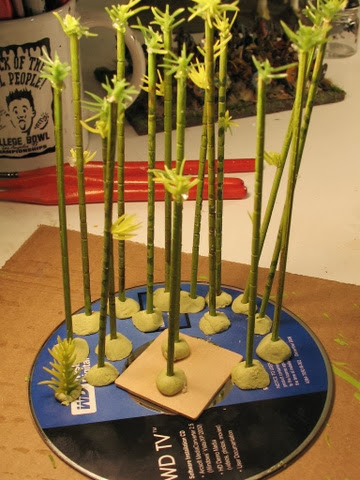
I started with a number of round wooden craft sticks, about 1/8" in diameter.  They seemed to actually be real bamboo, not that it makes a difference on a scale miniature.


At first, I placed the stick in the chuck for a hand drill and then held a small file against the "bamboo" while turning it. This created the segmented nodes on the stem. Having three hands would have helped in this process.  If one has a drill press (second photo below), there is less chance of breakage and the notches are better defined, but it is a slower process to change out.  


The notched bamboo was painted light green with craft paint.  Next, foliage from an aquarium plant was glued to the top and sides.  I detailed the cane with a black wash to highlight the segments, then some drybrush highlighting. 


The bamboo was attached to a CD base with Miliput putty, and then covered with a glue/paint/ballast mixture.


With a couple of these on the table,  the terrain is evocative of so many settings in samurai and wuxia films.  Maybe on my next piece, I'll figure out a way to let my models do this: 


Monday, August 26, 2013

Sohei Monks for Ronin


The origins of Japan's warrior monks start with the relocation of the imperial capital from Nara to Heian in the late eighth century.  Disputes broke out between monks from the two cities over issues of imperial favoritism and patronage.  In 949, violent conflict, on the level of street brawls and skirmishing erupted between rival orders.  As central authority declined in the eleventh and twelfth century, battles between the rival temples became larger in scale, and the Nara monastary fielded an army of over 3,000 Sohei. In the Gempei Wars of the 1180s, the Nara monks sided with the Minamoto clan. Their rivals, the Taira, so decisively destroyed the monks and their temple, that most Sohei stayed out of the remainder of the wars.

My Sohei buntai is mostly from The Assault Group, one of the few companies making models for the early Samurai period.  As always, their figures are truly a joy to paint.  Details are vivid, but not exaggerated.  The fabric on the robes is natural and shows off shading and highlighting.  I wish my painting did it better justice.


Not a lot of posing variance on the archers, but for a small warband, a shooting stance is what I want. 


The unarmed monk is center is something I have had since the early 90s, and recently repainted.  He can fit in as a Shugyosha.  Can anybody ID its manufacturer? 


Reading Background:

Japanese Warrior Monks AD 949-1603, by Stephen Turnbull and illustrated by Wayne Reynold. Stephen Turnbull is Osprey's go-to-guy for ancient and medieval Asian history and this is essential if one wants to learn the history, motivation and equipment of the Sohei.  Reynold's illustrations are very good with bold line work and nice color contrasts.

Japanese Fortified Temples and Monastaries AD 720-1062. Fortress Monasteries. by Stephen Turnbull and illustrated by Peter Dennis.  Across his numerous Osprey titles, Turnbull can be a bit redundant.  If one has the previous volume, Fortified Temples is probably non-essential.  Its focus on fortress monasteries has some potential for those wanting to build their own terrain. Most of the illustrations are architectural in nature, but a couple of Dennis' plates are battle scenes.  They lack the scope and impact of Wayne Reynolds, but are still useful for the painter needing reference. I also wonder if the title is in error, because the bulk of the material and illustrations deal with fighting monks and their castles well into the fifteenth and sixteenth centuries.

The Dragon Scroll, I.J. Parker.  In this Heian-era mystery, a young Japanese bureaucrat's investigation of tax irregularities in a province lead him to a nearby temple whose members have been instigating violence in the nearby village.  The lead character in the series, Akitada, is continually skeptic of Buddhism - or more likely distrustful of the degree to which the monasteries insinuated themselves into the corridors of power.

Monday, August 12, 2013

Andalusian Cavalry


My El Cid/Spanish project continues to expand with this unit of recently completed Andalusian Cavalry from Gripping Beast.  The set of ten contained a mix of Christian/Muslim knights, befitting the mercenary nature of some of the Taifa kingdoms' armies.


The only issue I have ever had with any Gripping Beast figures is the choppy or rudimentary look of the horses.  On these, I have no complaints.  The details are sharp, especially on the heads and harnesses.


Also completed this week, after about 6 weeks in the making, is this Norman watchtower.  I originally intended for it to be the keep for a castle complex, but that proved to be too ambitious.  Castles are nice to have, but there has yet to be a rules system that wants to fully tackle the intricacies of ancient and medieval siege warfare. The sides are built from Hirst Arts blocks and the floors from molded plastic sheets found in the railroad modeling section of a hobby store.


With that in mind, I changed it to a stone coastal watchtower with a hay signal beacon on top.  The floors and door are removable and can hold about a dozen models inside. 


The hay stack is made of Milliput and the groove on the side will be used to attach a steel wool "fire." Below, some Norman archers take aim.


I have some WIP photos that I might attach with a write up soon. 

Wednesday, August 7, 2013

New App Recommendation & Other Updates

While there has not been a great deal of posting lately here at Sea Kings and Horse Warriors, I promise I have been busy.  In late July, my armies of El Cid era Spain added 10 Andalusian cavalry, 25 Sudanese spearmen, a dozen slingers and some various Christian knights.

On the terrain front, I have built a stone Norman tower and most of a large Spanish church, both from Hirst Art blocks.  A lot of plaster has been poured in my garage recently.  Other terrain projects that have been completed are two farm houses, 4 lengths of wattle fencing and a small vegetable field. I will post some photos, but the Dullcote is drying slow in the rainy and humid South.

I have never reviewed or recommended a phone/tablet app, but this particular app seemed interesting.  I have never been a user of digital dice apps, preferring the primitive satisfaction of tossing the magical plastic onto a wood table, but at 50% off, Prime Dice D & D pro was in the impulse buy price range.  Of course, it has all of the D & D multisided dice, which can be rolled in various quantities and combinations.  Tapping on a single die rerolls that dice only.  It also supports multiple tables, so two players can roll their dice quickly by swiping horizontally from one background to the other.  There are some good stock backgrounds (pictured) but custom or personal backgrounds can also be loaded.  Even better, the dice themselves can be customized.  I immediately thought of the possibilities of story dice for my kids - loading images of dragons, castles, spaceships or dinosaurs. My first experiment was to create some virtual SAGA dice:


While not very practical (how can I put them on a battleboard?), I can see using the custom dice features in SAGA and other mini games for things such as random weather effects, civilian or livestock actions and other scenario specific situations.