Pages

Thursday, February 7, 2013

Spanish Military Service, 1000-1200 AD

My blog posting as been very sparse in 2013 to date.  Hopefully, that should change in the coming weeks, as I have been furiously painting Spanish, Andalusian, Berber and Sudanese armies for a series of posts and write ups in the coming weeks.


Forced into the mountainous north by the Umayyad invasion in 711 AD, the Christian nobility clung to the kingdom of Asturia.  In the ninth and tenth centuries, the Christian kingdoms restrengthened and gradually expanded south.  On the Spanish plains the Asturian kings needed to develop a strong cavalry force, capable of defending the frontier and operating with some degree of self sufficiency.

To encourage settlement on the frontier, small landowners were granted commissions of land in exchange for military service.  This was not a feudal relationship per se, the small farmers were not of high enough status to become royal vassals and there was no ritual performed on either party's behalf.  Rather, it was a contractual relation.  Into the eleventh century, settlement became more numerous and organized.  Towns were created by royal charters, called fueros, and land was granted on the basis of cavalry service (caballerias) and infantry service (peonias).

Caballero Hidalgos or later just Hidalgos - greater and lesser knights who did have a feudal relationship with the king or a count (comes in Spain).

Caballero Villanos - most important class in the towns of central Spain.  Along with a small number of hidalgos, they formed a urban military aristocracy that gave Spanish towns of the eleventh and twelfth centuries a different character than Italy, with its merchant elite. They functioned as light horsemen and the jinete, referring more to a style than a type of soldier, involved fast moving and maneuvering cavalry equipped with javelins.


Above, a group of hidalgo villanos. Though not as well armored as knights, their horses, shields and clothing indicate wealthier status. Below, several groups of foot soldiers. Figures are from Crusader Miniatures.


Below, a group of fairly well equipped spearmen, perhaps some urban militia. The two on the right are from Gripping Beast.


Peones -small landowners and tenants not able to afford a horse and the requisite equipment gave their service as a peones, or foot soldier. Better equipped and trained foot soldiers bore a shield, spear and sword.  Skirmishers, drawn from the shepherds or Basque hill people, were proficient with bow, sling or javelin.  

Below, Spanish archers in fairly colorful garb, probably from trade with Arabic merchants to the south. All figures from Crusader Miniatures


Duties of the Spanish soldiers were to guard the towns and frontier, especially the herds of livestock. Far from just defenders, Caballeros and Peones were expected to go on the offensive and raid enemy territory, be it Muslim or Christian.  Raiding was also an opportunity for advancement, with soldiers at all levels enriching themselves through plunder and ransom.

Military service was essential to the reconquest of the Iberian penninsula, but Spanish kings were well aware that overly burdensome terms of service would not attract the necessary populations to the frontiers.  Age exemptions only applied to those over 70 years, which speaks to relative health of older people in  pre-modern times.  As always, one could purchase their way out of service, and the fee was twice as much for a caballero as a peony.  Family situations were also considered, with the newly married or those caring for sick relatives capable of receiving temporary exemptions.

Wargaming the Period

There are several good options for wargaming the early Reconquista period.  I do not own a copy of the Warhammer Ancient Battles El Cid supplement, but it was quite popular.  Reconquista army lists for Field of Glory were found in both the Wolves from the Sea and Oath of Fealty supplements.

My current preferred large battle historical system game is Clash of Empires, and my eventual goal is to build a 2500 to 3000 point Spanish army.

SAGA is my other favorite game currently.  While a Spanish supplement is highly likely in the next year or two, adapting a current battleboard is the best option.  The three classes of men, Hidalgos, Caballero Villanos and Peones fit into SAGA's divisions, and the best analog is probably the Norman or Breton battleboard.


Sources

Lourie, Elena. "A Society Organized for War," Past and Present, No. 36, December 1966, pp. 54-66.

Powers, James ."Frontier Military Service and Exemption in Municipalities of Aragon and Castile, vol. 45. Military Affairs.

Friday, January 18, 2013

Portugal in the Age of El Cid

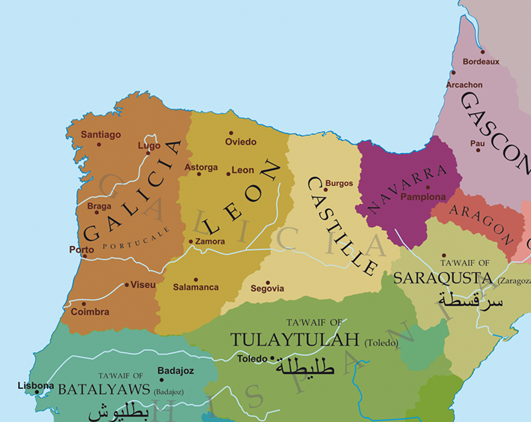
This post and hopefully the next few will be about an El Cid project a friend and I have worked on for almost two years. At various points we wrote our own rules, used other established rules systems, and now might try to get these into our SAGA games. I volunteered to paint a big chunk of his figures and he wanted them to represent a Portuguese force. Properly defined however, there was no Portugal in the mid to late eleventh century, the era of the Cid and the rise of Castile and Leon.  

Though Portugal was not recognized as a sovereign kingdom until 1143, the political separation of the western lands of the Iberian peninsula has a long history.  It was organized under the Romans as the province of Lusitania.  Following the Roman era, the Suevi tribes controlled western and northwestern Iberian lands until their absorption into the Visigothic kingdom.  The collapse of the Visigoths against the Arab invasion in 711 put most of the Iberian peninsula in Umayaad control. A small portion of the northwest, Asturia, was the refuge of the Visigothic nobility and the Basques controlled the mountainous northwest.

Under the Asturian king Alfonso III, western  territory was recaptured in 843 and the settlement of Porto Cale was established where the Duro River met the Atlantic.  As a buffer zone between Galicia and Al’ Andalus, Alfonso awarded it to his vassal Vimar Peres.


The ninth and tenth centuries were the golden age of the Cordoban Caliphate. Andalusia was the wealthiest and most sophisticated power in western Europe and though Islamic, attracted Christians eager to study medicine, science and work as mercenaries. The height of this power was reached under the vizier Al-mansur (Almanzor, 938-1002). He waged war on Castile and Leon, raiding as far as Santiago. After 1031, the political balance shifted decisively towards the Christian kingdoms. In that year, the last Cordoban caliph was removed and Andalusia was divided into numerous rival taifa kingdoms.  Meanwhile, the Christian kingdoms were consolidating under King Fernando the Great.  In the west, Fernando was campaigning well below the Tagus River on the Muslim held city of Badajoz. As Christian held land expanded around Porto, the County of Portugal was formed.  The Christian armies at this time were not actively looking to reclaim the peninsula for the extraction of tribute payment, paria, was much more lucrative than conquest.


Throughout the tenth century, the County of Portugal remained more or less a part of the Kingdom of Leon.  The death of Ferdinand in 1065 resulted in the division of his kingdom into three parts.  His eldest son, Sancho, received Castile; Alfonso, the favorite, received the heartland of Leon; and the youngest son Garcia was granted Galicia, which included the County of Portugal. In 1070, Count Nuno Mendes, a decendant of Vimar Peres, rebelled against Garcia and was defeated in 1071 at the Battle of Pedroso.  Thereafter, Garcia took the title King of Galicia and Portugal, the first to refer to it as a kingdom. 


Nuno Mendes, Rebel King of Portugal


Ferdinand's lands were not divided for long. In 1071, the two eldest sons attacked and divided attacked and divided Galicia, with some sources claiming that Sancho's alfarez Rodrigo Diaz personally captured Garcia. A year later, Sancho was dead, murdered by unknown assassins and Alfonso VI was king of Leon, Castile and Galicia. As for the county of Portugal, Alfonso named his son-in-law Henry, brother of the Duke of Burgundy, as count.  


Count Henry of Portugal


Alfonso death at age 72 in 1109 after more than forty years on the throne was the catalyst for Portuguese independence.  Succession was an open question. With only surviving daughters, the eldest, Urraca was widowed but with a male child.  Her sister Theresa and brother in law Count Henry were far from obedient vassals. Their child, Afonso, was finally proclaimed King of Portugal and captured Lisbon with English crusaders in 1147.

Wargaming Portugal

Historical opponents for an eleventh century Portuguese warband are plentiful and varied. Most obvious would be Andalusians and, later, the Almoravids. Equally prevalent as opponents was other Christian Iberians, or a combined Christian and Moorish force. While El Cid was a mercenary captain for the taifa city Zaragoza, he once fought off a raid that included the Count of Portugal.

The Portuguese elite was equipped and fought like the rest of Iberia's Christians, wearing mail, armed with spear and sword and with horsemanship skills that rivaled the Normans. As a frontier region, Portugal was more more heavily influenced by Andalusian dress and military styles. Infantry was comprised of property owning men from towns and their lord's estates who saw war as an opportunity for adventure and plunder. They were equipped with spear and sword, with the round shield giving way to the Norman kite shield later in the eleventh century. To defend against raids, peasant, especially those from shepherding backgrounds, were competent with the sling and javelin.

My next post will be a look at these skirmishers, and some historical fiction dealing with Reconquista Spain.

Sources

Fletcher, Richard. The Quest For El Cid. Oxford University Press, 1989.

Luscombe, David and Jonathon Riley Smith, eds. The New Cambridge Medieval History vol. IV c.1024 - c.1198 Part II. Cambridge University Press, 2008.

Nicolle, David. El Cid and the Reconquista 1050-1492. Osprey, 1988.

Maps from Wikipedia used under Creative Commons license.

Wednesday, January 2, 2013

Best Wishes in 2013

I hope everyone has had a great run of holidays in the past few weeks, and I hope 2013 brings all of you success and blessings.

Christmas was wonderful here and brought me a slew of wargaming gifts:


My wife gave me three packs of Welsh and the banner, and my parents gave me the Jomsvikings and fencing.  Thanks to Architects of War for having one of the easiest wishlist systems for historical games in the States.  

Now on to 2013 and my hobby and blog goals:

1) Reduce the Mountain of Lead (and plastic) - With the advent of the internet and frictionless purchasing, we tend to acquire more than we have the time to realistically finish.  This is true for almost any hobby I have seen - video games, crafts and scrapbooking, even fitness.

2) Clash of Empires - I bought the main rule book a couple of months ago, and I liked it enough that I ebayed by Field of Glory books.  A friend and I have built El Cid era Spanish and Moorish armies for a large scale battle system.

3) New SAGA Factions - I had a great deal of fun putting the Byzantine battle board together, and would like to do at least one new one mod in the coming year.  I am leaning towards Song China, but Medieval Africa (Kingdom of Ghana, Songhai) is also a historical favorite of mine.

4) Figures from Historical Fiction - I have been working on converting a few figures into characters from my favorite late antiquity/Dark Age historical fiction.  With a small reserve built up, I will post one a month with a book review and comments on using the character in a skirmish game.

I really appreciate all those who visited and left comments on my site in 2012.  The online wargaming community is one of the friendliest and most supportive hobby cultures I have encountered.

Monday, December 17, 2012

The Raven's Shadow Review

Last week, I received my copy of The Raven's Shadow from Architects of War, and have been absorbing the rules, and playing some solo practice battles.  The second expansion to the SAGA game shows that Studio Tomahawk is willing to take the basic gameplay in some unexpected directions.

Franks: The Battle Pool mechanic was one that I never quite understood when reading the early descriptions.  When reading the book, it is not as complicated as it seemed.  A player of the Franks has the ability to place up to three dice in the Battle Pool.  The effectiveness of other abilities on the Battleboard depend on how many dice were allocated to the Battle Pool.  This faction's challenge lies in the fact that one has to place dice in the Battle Pool, dice on abilities and still have enough dice left over to activate units.  Players using the Franks will probably use larger units and depend on the We Obey rule.  In fact, the Frankish hero Charlemagne can activate up to three units at a L distance as one of his special abilities.  If you are like me, and like to play quick four or five point games, I am afraid the Franks would be of limited use in such situations.

Irish: Similar to the Welsh in that they are lightly protected fighters who must take advantage of the terrain, the Irish faction shows some serious modifications to the rules.  Hero characters called the Curadh are able to operate independently of units and fight as individual warlords to a degree.

Norse Gael - A Viking faction, and like the Jomsvikings from the previous supplement, its variation is in giving the opposing player a choice. Instead of increasing wrath, the choice is a single combat challenge between a Norse Gael figure and an enemy figure.  Winning the combat allows the Norse Gael player to unlock special abilities.

Strathclyde Welsh - a interesting faction choice, for it was a small kingdom that was eventually absorbed into Scotland in the early eleventh century. The units are not all required to be mounted as I previously assumed, but their new abilities depend upon mounted units.  In this case, the new feature is off-table units. With proper activation, they can enter the battlboard from any side, and another ability allows them to make a shooting attack from off the board, if an enemy is within L of the table edge. Should SAGA move into the East, this would be a useful mechanic to handle steppe factions such as Seljuks or the Pechenegs.

The evolution of the rules in The Raven's Shadow does have the potential to slow the game down some, especially with the insertion of more Reaction based abilities, but that should decrease as players become more accustomed to the process.  The faction choices are good, but one must decide what is right for their style of play.  The Franks require an efficient and calculating manager.  The Irish will be favored by the gambling player, who is willing to take a chance on big victories if a "6" can be rolled.  The Norse Gael have some of the most interesting Hero abilities (Brodir of Man's seer powers seem quite fun) but Challenges may be gimmicky like the Jomsviking's wrath.  My preferred faction from this update will most likely be the Strathclyde, because I am eager to see how the off table abilities play out.

Mounted Welsh kit bashed from two boxes of Wargames Factory Ancient Germans with Saxon and Viking heads and weapons. I added javelin quivers and green stuff cloaks to a few.


Not the paint work I am most proud of, but I did manage to complete about 18 mounted figures in a week. Pictured below is all 24, which is three points worth of warriors. Adding in a unit of levies and two hearthguards will be the final warband.


Monday, December 3, 2012

Scots

A small confession on the advent of the SAGA expansion, Raven's Shadow - I have not yet played any of the factions from the last expansion, Northern Fury.  When I got back into gaming after a long absence, I filled my shelves with Vikings and Saxons (thank you, Bernard Cornwell).  An itch for Normans hit me after buying SAGA and reading some Jack Ludlow.  After turning some Wargames Factory Ancient Germans into Welsh, I have ended up with at least 6 points of all four original factions.

Then came the Jomsvikings, Anglo-Saxons, Bretons and Scots.  Obviously, the first three are analogous to original factions, with some differences.  The Jomsviking wrath mechanic was interesting, but gimmicky.  The Anglo-Saxon battleboard, with bonuses for large units, does not suit my style of play and the Bretons...liked them, painted a unit of skirmishers, and have every intention of getting them on the table.  Which brings me to the Scots.  The Scots battleboard is intriguing, and seems to demand a bit more forethought and strategic positioning of your forces.  Hopefully, my game next weekend can be a four point match up, with two hearthguards and two warriors.


Above and below, Thanes by Crusader Miniatures


Scots warriors


I was not able to find any conclusive or well documented depiction of pre-heraldic Scottish shield designs on the net.  So I went with vaguely Viking designs with some Celtic influence, borrowing liberally from a few other blogging wargamers.  

Reading Suggestions:

Clarkson, Tim, The Makers of Scotland: Picts, Romans, Gaels and Vikings. A highly readable look at the evolution of Scotland from pre-Roman times until roughly the year 1000.  The first third of the book suffers a bit from the authors attempt to weigh primary sources and chronicles, and ends up focusing on royal names and succession, rather than on the peoples and cultures promised in the title.  After working through this, Clarkson ends up delivering some valuable information about the development of the Scots, culturally and politically.  As a further inticement to SAGA players, the the forthcoming faction the Strathclyde Welsh also play a prominent role.

Dunnett, Dorothy, King Hereafter. Previously recommended, a historical novel in which Dunnett proposes that Macbeth and Thorfinn of Orkney were not cousins (or half-brothers) but one in the same.


Saturday, November 24, 2012

Song of Blades and Bricks

Introduced my daughter (age 8) to wargaming this weekend with a slightly simplified version of Song of Blades and Heroes.  For figures and terrain, we used Lego minifigs and bricks.

The scenario was simple: get across the pond, through the ruins, get the treasure and get out.


My warband was built for power, 2 Minotaurs, 2 dwarves and 1 dwarf magic user.  My daughter went for stealth and magic - 2 wizards (Harry Potter and Hermione), 2 barbarian cave girls, 1 thief (Red Riding Hood) and a crossbow wielding Hagrid.


While the magic users transfixed my fighters, Little Red Riding Hood sneaked into the ruins and got the treasure. 


The "bad" warband did manage to get back on their feet briefly: 


Hermione versus a Minotaur: 


Red takes out a Minotaur that Harry Potter transfixed:


...and that was the game.  A fun afternoon game, and my daughter grasped the concept of activation and combat rolls very well.  I was impressed that she learned on her own some basic tactics and gameplay exploits - her favorite was transfix with a wizard and then attack with the crossbow.  Two additional educational benefits from the game: quick but basic mental math computation and use of the metric system, both of which are skills not sufficiently taught in American primary schools.

Hopefully, I will soon post pics of my recent painting efforts, a few units of Scots that I have been working on for SAGA, and some El Cid Spaniards for a friend and fellow gamer.


Sunday, November 11, 2012

Song Dynasty


     The Song Dynasty of China was easily the most wealthy and technologically advanced society in the world in the tenth and eleventh centuries.  Much like their contemporary empire to the west, the Byzantines, the Song Dynasty fought nomadic and semi-nomadic peoples who desired the great wealth that abounded in their kingdom.

     To historians and wargamers, the Song Dynasty gets little credit due to its military and diplomatic blunders. After losing territory in the north to the Jurchen people's Jin kingdom, Song policy makers too slavish followed the maxim 'the enemy of my enemy is my friend,' and they cultivated an allegiance with the Mongols, who were north of the Jin.  When the Mongols turned their sights on the Song after destroying the Jin, China placed far too much confidence in their defensive walls, and were not prepared for the Mongols' mastery of siege warfare. The Song held out longer than many of the Mongol's enemies, but finally fell in 1279.

On the other hand the Song Dynasty lasted about three centuries, if one counts both the Northern Song and the Southern Song periods.  That Dynasty can also be credited with developing a standing navy and the implementation of primitive gunpowder weapons into its army.


It was my first purchase from The Assault Group (what a great name, by the way).  The sculpts are excellent, and look to be based on some Song-era iron sculptures that are still extant.  A pack of four contains four unique figures, and the conscript spearmen could probably used for most any era of China from the Warring States period through early Qing.  While a bit chunky, they are comparable in terms of size and heft with the Crusader Miniatures line.  

I would love to build a huge army for Clash of Empires, my favorite 'big battle' system, but that is definitely a year away, at least.  In the short term, I imagine adapting the Song into SAGA using a Byzantine battleboard.  After all, both were heavily missile based armies who had adapted their armies to fighting steppe nomads.  Other battleboard abilties should take advantage of China's capacity for levies, as well as some limited abilities based on the psychological effect of firelances or thrown bombs.

  
Reading Suggestions


Tun Huang by Yasushi Inoue. Inoue, Japanese writer of historical fiction (1907-1991), produced this novel in 1959 about Chao Tsing-te, young Chinese scholar in the early eleventh century. He misses his civil service exam by an accidental nap and after a chance encounter with a woman and a mysterious scroll, he wanders westward towards the title city. Again by accident, Chao finds himself fighting in the Song army against the Xi-Xia.  Like a Japanese woodcut, the beauty of Tun-Huang is in its simplicity; an adventure novel, and the search for meaning in the randomness of life.